Ed Anderson wrote:

snips... in the interest of civility which is important on this newsletter.
 Hi Paul,

    Been meaning to ask you about the hole in the rear bearing.  I indeed
examine mine and traced the oil flow circuit to understand the function it
(the hole performed).  As best I could figure it out, it was simply the oil
drain from the main bearing.  If indeed that is its function, I fail to see
what real significance its orientation has as the oil flow from the bearings
would appear to flow out of it (pushed out by the new oil flowing into the
bearings) no matter its orientation.  True it would undoubtedly flow better
oriented at the bottom, but my question is the difference really
significant??

Best Regards

Ed Anderson.
It somewhat depends on where it goes from there if it turns left looking
at the back of the engine it could cause more pressure on the rear seal
perhaps blowing it and all your oil out of the engine. Even if it goes
stright down the pressure could be higher if the oil had to force its
way out in a plugs up configuration.

That is only one of many oiling and cooling potential problems with the
plugs up orientation. We have enough trouble installing and cooling these
things without asking for more problems.

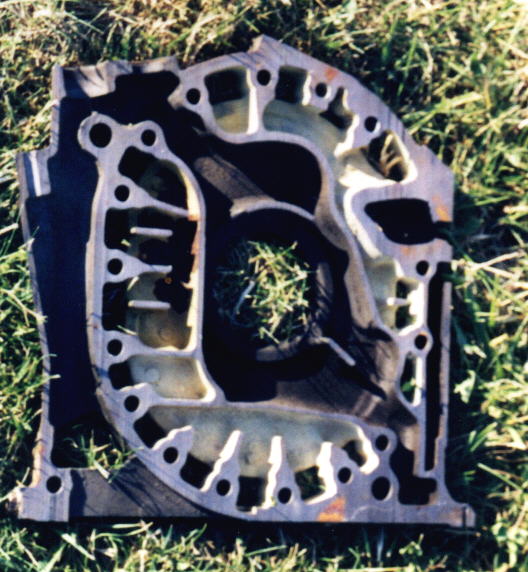
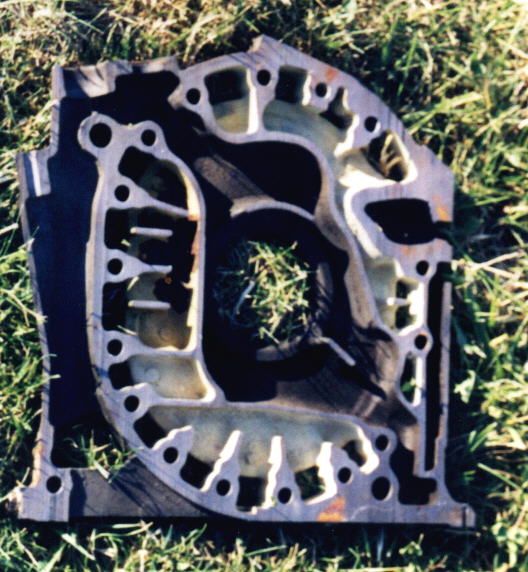
Here is another picture of the cut-away center housing that is also relevant
to the last message. The black parts are the oil drain backs.
These are just the things that I know about now. I have never seen inside
a front housing.

The rotary engine is a lot more complicated than it looks when you
look inside the end and center housings. Mazda spent years and tons of
money developing this engine and there is a very good reason for everything
you see. It does not pay to second guess them on anything.

There is also a very good reason for having the water pump mounted
where it is. Rotating the engine defeats that purpose.

It is a total lie that the engine is lower when rotated 90 degrees
in the plugs up orientation. The distance from the e-shaft center line
to the tips of the plugs is actually more than it is to the tops
of the housings. Only in the early engines when one was forced to
use a distributor was it perhaps advantageous to run the engine
plugs up. Even then, with a little help from an electronics technician,
a crank trigger could have been devised for the ignition system.

I suggest getting all the SAE papers and all the engineering books you
can find and read up on the development of the rotary engine.

Paul Lamar

The Aircraft Rotary Engine Newsletter.              Powered by Linux.

http://home.earthlink.net/~rotaryeng/            http://www.linux.org