John Slade wrote:
Bear with me, I have another dumb question...

I've seen some discussion on ducted fans and I
know there's one guy
experimenting in this area, but most seem to favor
the PSRU approach. Could
someone explain why running a smaller prop or fan
at 5000 rpm isn't a good
alternative to a PSRU?

John Slade, Cozy MKIV #757, progress:
http://kgarden.com/cozy
West Palm Beach, FL
I knew I had this around here somewhere.

This is one of those all other things being equal.

Read turbo prop merely as prop driven airplanes.
I forgot where this came from. Probably Treager,
Aircraft Gas Turbine Engine Technology.

Paul Lamar
The desire for larger props has to do with the laws of
physics as related to propulsion. Thrust is mass times
the change in velocity. you can make the same amount
of thrust with 100 units of mass and 10 units of
velocity or 10 units of mass and 100 units of air
velocity.
However the horsepower that you have to put
into the air is a function of the square of velocity.
This is a real major killer at static conditions where
this relation ship is direct and the first case is
100*10*10
for 10,000 units of power and 10*100*100 for the
second case which becomes 100,000 or 10 times as much
power for the same thrust.
Mass flow is a function of
the diameter of the "tube" of air you get to work on,
which is close to the diameter of your inlet(prop).
This is why helicopters with 150 hp swing about a 30
foot prop.
As you go faster this becomes less of a problem
because your "tube" is running into a lot of mass of
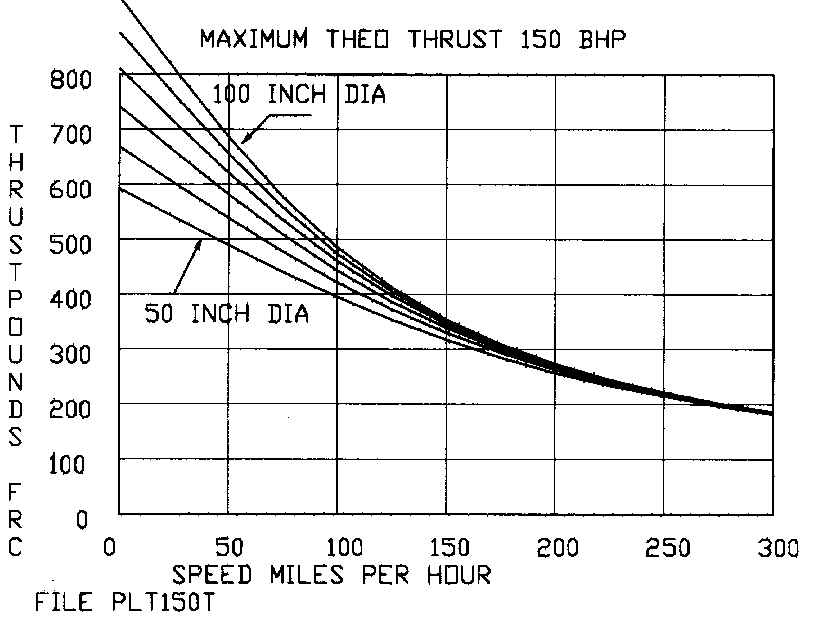
air. The curve attached shows this effect, and is
based on having 150 HP which is pretty common. Each
curve assumes that you are able to put that 150 hp
into your tube of air perfectly with no loss ie a
perfect air pump with that inlet diameter. Propeller
diameters are pretty well controlled by tip Mach
number.
A duct inlet
can help you fool the air into thinking it is a bigger
pump at low speed, but the duct drag quickly erases
that gain as forward speed is increased. Props, fans,
ducts, and flapping wings all got to live by these
rules, and the real world is always below the line.
These lines also ignor the fact that the body drag
inside the smaller, faster "tube" is another penalty,
but you can make the smaller props work - specially on
clean fast planes - Vance
Great post Vance. Explained well. Thanks.

I am a ornithopter fan myself. Especially the X wing (dragon fly) variety
as they are more or less balanced. The "tube" you have to work with is
the size of the wing span.

Paul Lamar

The Aircraft Rotary Engine Newsletter.              Powered by Linux.

http://home.earthlink.net/~rotaryeng/            http://www.linux.org