| Subject: smaller props / ducted fans air torque converter. |
| From: Paul |
| Date: 12/25/1999, 9:00 AM |
Howard Wilkinson wrote:Vance: My thinking is that you have nothing tolose..... that is over a simpleduct fan. Any energy which is not imparted to thesecond and larger prop isdirect thrust.... it all exhausts out the back ofthe duct. The more torqueyou can impart to the large diameter blades themore you gain. Efficiencywould not be on par with a gear redrive, butbetter than a small duct alone.Losses would be no more than bearing drag andaerodynamic drag of the ductwhich you would have with a duct fan. The system would be lossy indeed if youdepended only on the thrustgenerated by the large diameter prop.Conventional duct fans have notproven to be successful for most applications,redrives create all kinds ofproblems... with this you have no concern for thetorsional vibrations,lubrication, cooling, etc you have with aredrive..... how much is lost???I suspect less than with a simple duct systemdesigned for a 6000 RPM prop.(I say simple with tongue in cheek).H.W. The Aircraft Rotary Engine Newsletter. Powered by Linux.
Vance Jaqua wrote:
Howard - you make a valid point in that much of what
would normally be dismissed as a loss would still be
providing some useful thrust. Backing off and looking
at it what you have described could be considered a
direct drive turbo prop (unducted fan) being driven by
a sort of positive displacemt core engine making
turbine inlet flow instead of a "jet" core "gas
generator". The turbine drive for the prop needs a
high linear blade velocity to keep the efficiency from
being hoplessly low. The GE
unducted fan tried to get around the relative velocity
somewhat by counter rotating the drive turbine
sections. You are now talking about a double turbine
rear frame with two full sets of bearings - oops -
there went the simplicity, and you are still talking
about much higher loss  than the redrive. Prop sizes
for 4000 rpm piston powered drive can probably be made
to work reasonably for fast planes but with the 3 to 1
internal step up of the Wankel the 6000 rpm props
start
sufering a double hit from low mass handling at low
speeds and heavy blockage from the fuselage - Vance
Pod mounted engines would mitigate the losses from the fuselage.
The rotary engine will fit in an 18 inch diameter tube.

One of the things I like about Howard's idea is the twist energy
imparted to the airflow from the small ducted driving fan can be efficiently
recovered in the prop driving turbine. In a simple ducted fan this energy
must be converted to forward thrust by stators which in and of themselves
are lossy.

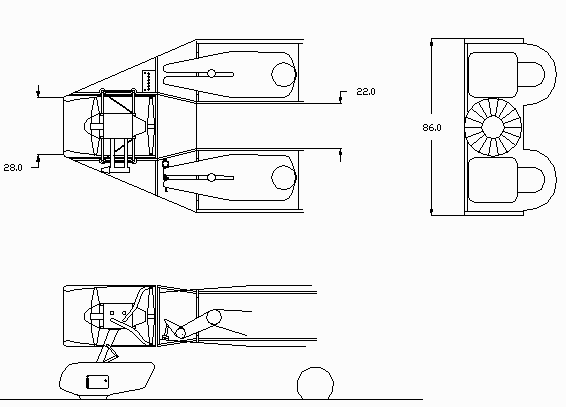
BTW here is an idea along these lines I had several years ago.
It uses the waste exhaust energy to drive a second fan in the duct.

The motor mounts shown could be simplified by using the bushings-in-the-
firewall trick.

Paul Lamar

The Aircraft Rotary Engine Newsletter.              Powered by Linux.

http://home.earthlink.net/~rotaryeng/            http://www.linux.org