Joa wrote:
Is it four keys or two and why are the keys needed if the friction from the
taper lock provides the torsional resistance?  Do only the four (or two)
woodruff keys contact the prop flange or does the entire surface of the
tapered shaft contact the flange????

Thanks.

Joa
______________________
PIW Engraving and Milling
      "Affordable CNC"
These are good questions Joa so don't be embarrassed about asking them.

There are only two keys. They do some of the work preventing the shaft
from rotating on the taper. They also hold the flange from rotating
when the large nut is torque down. The entire surface of the tapered
part of the shaft contacts the tapered part of the flange. Tapered
shafts and flanges have probably been used for perhaps two hundred years.

In a lathe the only thing keeping a  large drill from rotating in the tail
stock is a taper fit.

The way this Mantyla PSRU is designed it is necessary to
have a removable flange so the bearings can be serviced. With
the Power Sport method of attaching the shaft to the ring gear the
flange can be pressed on to a non tapered shaft such as Tracy and
Ross are using.

In the Ross and Tracy cases however, unlike the Power Sport design, the
flange must be pressed off to service the bearings. In the Ross and
Mantyla  cases the shaft is welded to the ring gear. In Tracy's
case the shaft is connected to the ring gear with about a 1-3/8
inch diameter spline so the shaft, flange and ball thrust bearing
come out of the box when the front cover is unbolted.

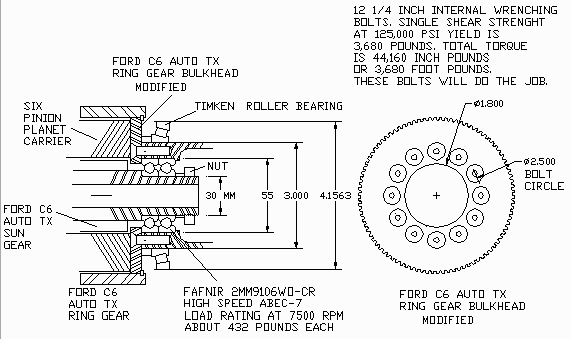
In the Power Sport case (and in the case of the design on the ACRE NL web site)
a dozen or so 1/4 inch machine screws hold the three inch diameter
(very strong) shaft to the ring gear so the bearings can be serviced
with out pressing the flange on or off. See the attached drawing.

All of this has been discussed on the NL so it is on the CD.

Paul Lamar

The Aircraft Rotary Engine Newsletter.              Powered by Linux.

http://home.earthlink.net/~rotaryeng/            http://www.linux.org