Gary Casey wrote:
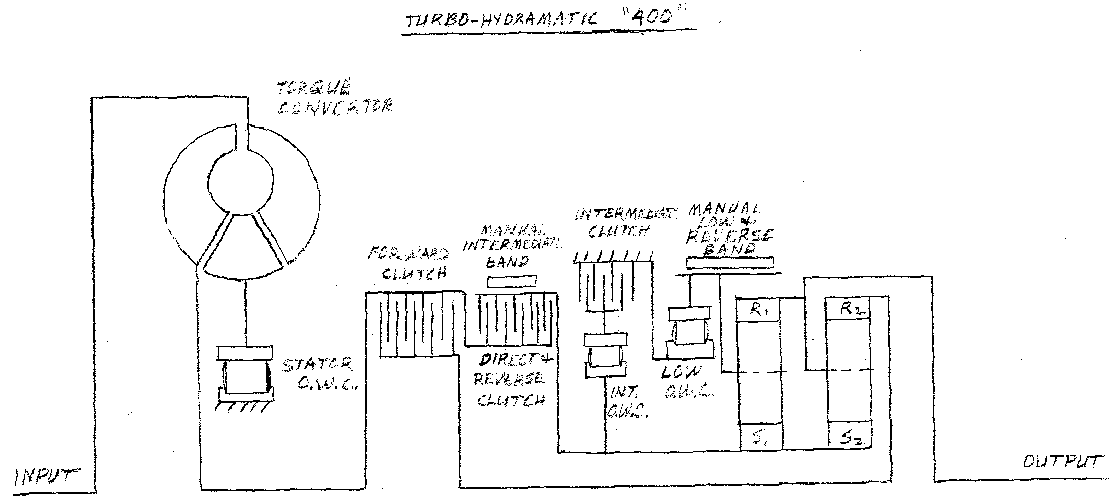
Here are some diagrams of transmission gearsets that I had handy.  I hope they are in a
usable format.  The Turbohydramatic 400 has one of the strongest gearsets around. Note
that there are two carriers (Just as in the Ford transmission) and a common sun gear.  I
forgot the number of teeth, but the ratios are 2.48 and 1.48.  I think this puts the
reverse ratio, which I think is the one people usually use for a PSRU, at 2.08.  The
Turbo 350 and both the Torqueflite and Ford use the same basic arrangement, but with
different ratios.  As long as the tooth numbers are the same for both sets the first
gear ratio is 1 plus the second gear ratio.  I think the Turbo 350 is 2.52 and 1.52.
Later one gearset was changed on the Turbo 350 which I think changed the first gear
ratio to 3.08.
In first gear the sun gear rotates backwards at a pretty high speed.  As
I recall, the planet speeds are as high as 12,000 rpm in first gear.  Now reaching way
back in my memory, I recall the sun gear being 48 teeth, the ring gear 100, and each
planet 26.  The problem is if you want to use the ring gear as the output with a
stationary carrier, the planet speeds are 1.85 times the sun gear, or about 12,000 rpm
with an engine speed of 6,500 rpm.  To make it live under these conditions takes very
careful control of the lubrication of the planet needle bearings.  Take a look at the
Powerglide transmission arrangement.  It uses a sun gear for the input and another for
the reaction element and the carrier is the output.  The ring gear can be thrown away as
it is used only for reverse.
The gearsets were made in  "light duty" and "heavy duty"
versions with the latter having a 1.76 ratio.  This gearset is remarkably durable and it
was used as-is in the early Chaparal race cars that were pushing 1,000 hp. One advantage
is that without a ring gear to support, the housing is very simple in design.  The
output shaft is very strong and could be machined to accept a propeller with no
problem.  I would suggest plain bearings on the output shaft with a pressure lube system
from the engine.  The only problem I see for use with a rotary is the reduction ratio,
which would give a prop speed of 3,700 rpm at 6,500 engine speed.  Why not reduce the
engine speed to 5,000 (prop speed 2,840), add more boost, and end up with a more durable
package overall?

Gary
Had to be really early Gary as I worked at Chaparral in 1965 and later and the gear
box
was a spur gear with torque converter arrangement. No planetary. Face dog engagement
and one had to shift. No clutch however.

Paul Lamar

The Aircraft Rotary Engine Newsletter.              Powered by Linux.

http://home.earthlink.net/~rotaryeng/            http://www.linux.org