npeckler wrote:
Paul,

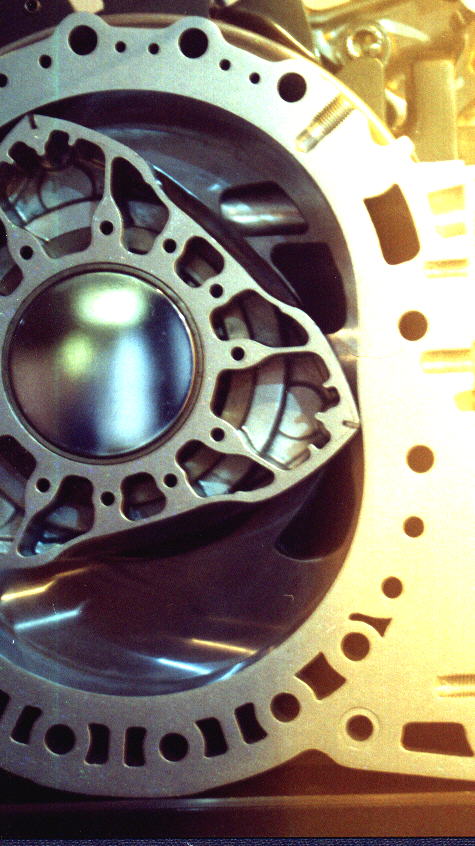
What are the classic problems related to replacing the end housings?  This
seems like the best road to generating a two rotor engine that produces 150
hp at 200 lbs.  I know that Lou Ross casted some, but don't remember the
problems involved.  Is warpage of the steel plate the problem?  Sealing?
What are the basic existing weights of the individual components?  Does the
newest rotary from Mazda make it easier to accomplish with the relocation of
it's ports?
I don't think warpage of the steel plate would be a problem. The temp is
less than 220 degrees.
It is clamped between the rotor housing and the aluminum part of the
end housing. The steel main bearing and phasing gear also hold
it in place. Also the rotor itself tends to keep it in place. If 1/8
proves to be a problem go up to 3/16.

Wear coating aluminum castings is expensive at the least and problematical.
Even Wankel Germany has a certain amount of rejects on housings.

End housing weigh 35 to 45 pounds each. Rotors are about ten pounds.
Rotor housing are about ten pounds also as is the e-shaft.

1/8 inch thick steel plates would be about 4 pounds each and you need four
so that is another 16 pounds.

The new side exhaust port version would be very difficult to make with
aluminum end housings  and not worth it for an aircraft engine. It has
mainly smog advantages. A peripheral port engine with light weight rotors
will generate about 280 HP normally aspirated at 9000 RPM just like the
new side exhaust port engine. You would need a 3:1 PSRU of course.

At 6000 RPM such an engine would make about 210 HP.

Paul Lamar

The Aircraft Rotary Engine Newsletter.              Powered by Linux.

http://home.earthlink.net/~rotaryeng/            http://www.linux.org