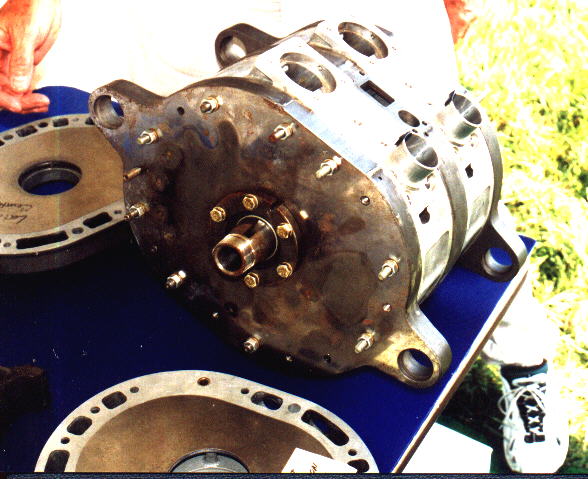
O.K., I just looked at some photos of Allan Tolles superlight motor and it
looks like they made their own rotor housings and end housings. It would be
interesting to see how they did it- how did they make the coolant passages in
the end housings? Not that  I am comtemplating undertaking any such project
-it's well beyond my abilities. But if anyone else is contemplating it, then
it would be cheaper to do it in volume. Hint, hint.
Brian Trubee
Redmond, Wa
I think those rotor housings were modified Mazda parts. I have a few pictures
of that engine around here someplace I took when I was up at Everett's shop
before he died. Ah yes is a picture taken at Oshkosh.

I am no casting expert by a long shot but I think you use what is called a
core box to make hollow castings. Correct me if I am wrong Howard.
The wooden core box is used to make a sand model of the insides of the water
jacket. Then you need another wood pattern for the outside shape of the end housing.
The patterns can get expensive for hollow casting like engines blocks and heads.
There is a lot of esoteric expertise only acquired by experience.

These are some of the reasons I like the two piece end housing idea. Once you have
the NC program you can make small quantities quickly out of high strength
billet aluminum. No porosity and no core shifts. When you are done machining you
are done.  Improvements are easily made at any time by merely changing the NC
program.
With a casting you still need to machine it, send it out for coating and lap it.

Paul Lamar

The Aircraft Rotary Engine Newsletter.              Powered by Linux.

http://home.earthlink.net/~rotaryeng/            http://www.linux.org