Vance Jaqua wrote:
OK you have my program so adjust the rates of change
of HP with
RPM and prop efficiency with aircraft speed to
reflect what
you feel are the real world results.

For example what kind of efficiency can we expect at
10 MPH
with a constant speed prop?
I will adjust the efficiency from 10 to 50 MPH in a
linear
or other math function and do a separate chart for
the constant
speed prop.

So the engine would only bog to 2100 RPM rather than
1986 RPM
What HP do you guess a 100 HP engine would be
generating
at 2100 RPM. I can fix that.

Paul Lamar
Paul - using several pages of print outs from PRPLRIT'
and other sources this is the table I came up with for
a 160 hp engine (like 320 Lyc) with a prop sizeds for
about 190 mph for a clean RV6 or KIS two place class
of airplane.
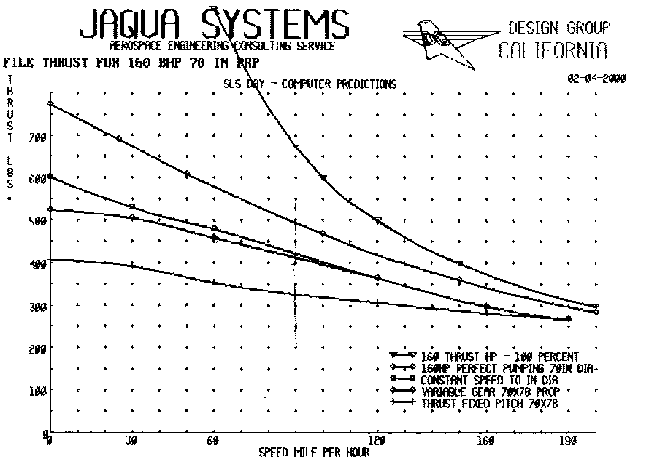
fixed pitch 70X78             const spd   var gear
   mph  rpm   bhp f lbs eff    f lbs eff  f lbs eff
    0   1940  108  407   0      603   0    525   0
   30   1950  109  393  28      530  26    505  25
   60   1960  110  353  51      480  50    460  47
   90   2080  118  327  66      425  63    420  62
  120   2400  130  307  76      366  73    365  73
  160   2500  149  283  81      299  80    299  80
  190   2720  160  268  83      268  83    268  83

The attached set of curves shows the relationship in
perspective the top curve is 100 percent propulsion
eff the same as if you had a sky hook and a wtless
frictionless infinite transmission, The next one down
represents 160 horsepower delivered without loss into
the air stream of prop dia - perfect 70 in prop,The
next down is a constant speed prop operated at full
160 hp rated rpm max man pressure - best pitch, next
is a variable transmission turning the 70X78 prop at
the right speed to absorb the 160 bhp, and the lower
one is of course the fixed pitch prop with the engine
turning the rpm that it can - direct drive - usual
airplane configuration. Both of the curves spinning
the fixed pitch prop show the result of poor l/d ratio
of the high pitch at low forward speed. Tho I would
not warrant the data to 3 decimal places, I am
cnvinced it is a good representation of real world
operation - Remember that eff is the ratio of thrust
hp to delivered shaft hp that is how you can have more
thrust even tho eff is down - Vance
The Aircraft Rotary Engine Newsletter.              Powered by Linux.

http://home.earthlink.net/~rotaryeng/            http://www.linux.org