Jeff Spitzer wrote:
The tension bolts have nothing to do with it.  I'm not concerned with the
steel bowing at the edges, only in the middle.  The actual temp of the
plate is not an issue.  The real question is what is the heat flux through
the plate?  If you happen to know this number (varies by location) then it
is a simple matter to figure out the delta T based on the conductivity and
thickness.  Actually, only the flux and K are required to figure out the
radius of curvature based on delta Temp/delta thickness.  Anyway, it bows
in the middle, bangs into the rotor, and don't seal worth a damn.  The
nicasil, OTOH, does not wear out so your concerns are unfounded for normal use.

Jeff Spitzer
How do you know if you haven't tried it?
According to Mazda the heat flux is very low on the side housings.
If the distortion is less than the side clearance it won't "bang into the rotor".
As I said before, most of the heat flux is adjacent to the rotor housing.
So the clamping effect between the rotor housing and the aluminum part
of the end housing minimizes the distortion of the steel sheet in that area.

You are being entirely too pessimistic about this. If it can be made
to work it is a breakthrough in low cost, home made, light weight end housings.
If .125 thick does not work try .187 thick steel. Furthermore steel, unlike aluminum,
can be chrome plated at low cost for even less wear than hard cast iron.

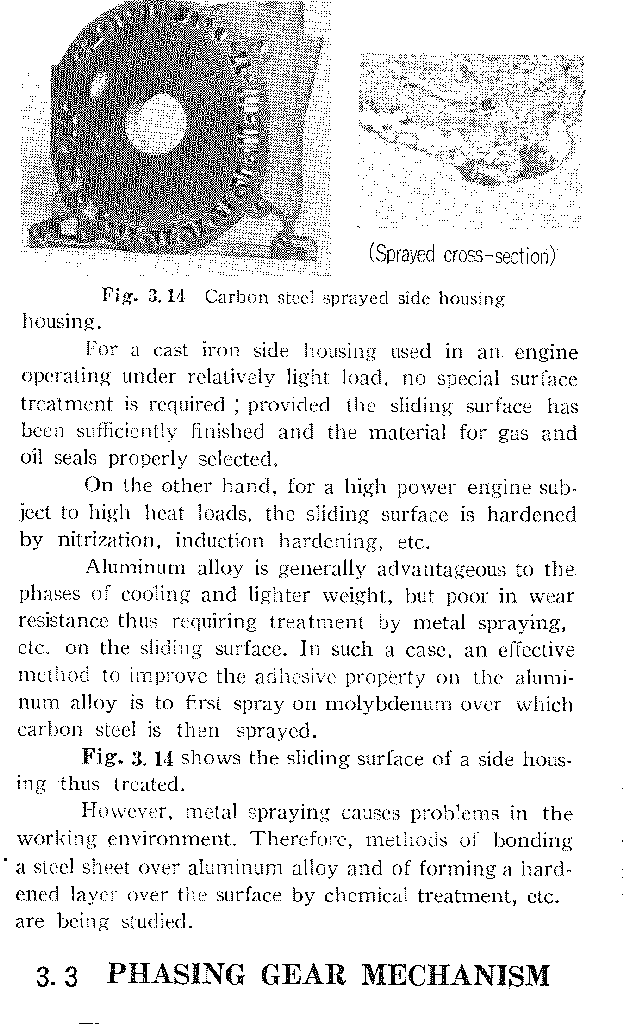
Here is what Kenichi Yamamoto says about it in the 1981 edition of the Rotary Engine.

Paul Lamar

The Aircraft Rotary Engine Newsletter.              Powered by Linux.

http://home.earthlink.net/~rotaryeng/            http://www.linux.org