Vance do we agree that HP can be converted to a
thrust at any given speed?

Here is a little quiz. If we come up with the same
answers we will agree
on the definition of prop efficiency.

What is the HP out of the prop for an airplane going
a steady 200 feet
per second with a drag of 200 pounds?

The engine in this airplane is generating 100 HP
which we know from measuring
the torque into the prop and the engine RPM.

What is our prop efficiency under these
circumstances?

BTW I am going to get around to doing a chart
showing how the angle of
attack of a fixed pitch prop changes as RPM changes
from 2100 RPM
and zero MPH up to 180 MPH and 2700 RPM. With this
chart one
could look up the L/D and C sub L and C sub d as
functions of the angle of
attack. I'll do this any day now :-)

Paul Lamar
Vance Jaqua wrote:
I use the same defination as you do - now increase the
engine power to 150 by reducing the pitch on your
constant speed prop - you stay at 200 ft per sec - but
now you are climbing so the thrust -s 280 pounds (drag
plus climb vector) and what is your efficiency? it was
72 and now it's 68 this is the effect I was talking
about.
As far as a chart of the angle of attack and lift drag
effects - you also need the air velocity thru the prop
which is different than airplane velocity (higher).
The program I gave you will calculate all that, and if
you select the long printout it will give you more
data than you wanted to see.
Sorry I missed you today at SP, Alex said the flu had
you down - it was a great turn out and great display
on a beautiful day. - Vance
OK I am interested in a rough approximation so I will accept a
5% error due to the disk loading effects.

Now getting back to the constant speed prop verses the the fixed
pitch prop verses the infinitely variable gear box driven prop.

Lets look at the constant speed verses the fixed pitch prop.

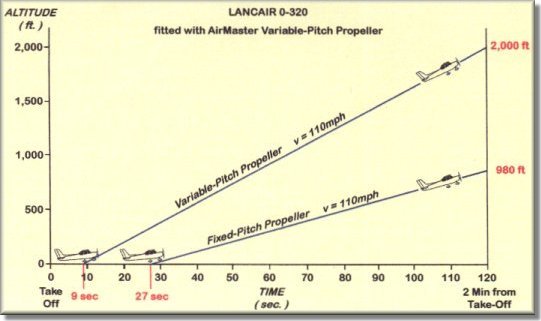
Let us say the fixed pitch prop operates at about 2200 RPM and 120 HP on average
while the constant speed prop engine runs at 2700 RPM and 150 HP and
while the O-320 Lancair accelerates from zero to a rotation speed of 100 feet
per second.

It took 27 seconds for the fixed pitch prop to reach 100 feet per second and
only 9 seconds for the constant speed prop to reach 100 feet per second.

Let us also say the gross weight of this airplane was 1600 pounds in
both cases.

The average acceleration with the fixed pitch was about 3.7 feet per second per
second or .11 G. While the constant speed prop did it at 11 feet per second per
second or .34 G.

F = W * G's so in the fixed pitch  case we had an average thrust of 176 pounds
and 544 pounds average in the constant speed case.

At 50 fps we have available out of the 120 HP 2200 RPM engine 1320  pounds of thrust
or a prop eff of 13%. (thrust in/thrust out. HP in/HP out).  Out of the 150
HP 2700 RPM constant speed engine we have 1650 pounds of thrust or a prop eff. of
32%.

Here again is your chart.

fixed pitch 70X78             const spd   var gear
   mph  rpm   bhp f lbs eff    f lbs eff  f lbs eff
    0   1940  108  407   0      603   0    525   0
   30   1950  109  393  28      530  26    505  25
   60   1960  110  353  51      480  50    460  47
   90   2080  118  327  66      425  63    420  62
  120   2400  130  307  76      366  73    365  73
  160   2500  149  283  81      299  80    299  80
  190   2720  160  268  83      268  83    268  83

I think there is something wrong as you show the eff. for the constant
speed prop at 30 MPH (44 fps) being only two points difference than the
fixed pitch prop.

Your number for the fixed pitch prop is way too high IMHO.
I don't think the difference in disk loading can make up for such
a wide discrepancy.

Paul Lamar

The Aircraft Rotary Engine Newsletter.              Powered by Linux.

http://home.earthlink.net/~rotaryeng/            http://www.linux.org