Vance Jaqua wrote:
--- Paul <rotaryeng@earthlink.net> wrote:
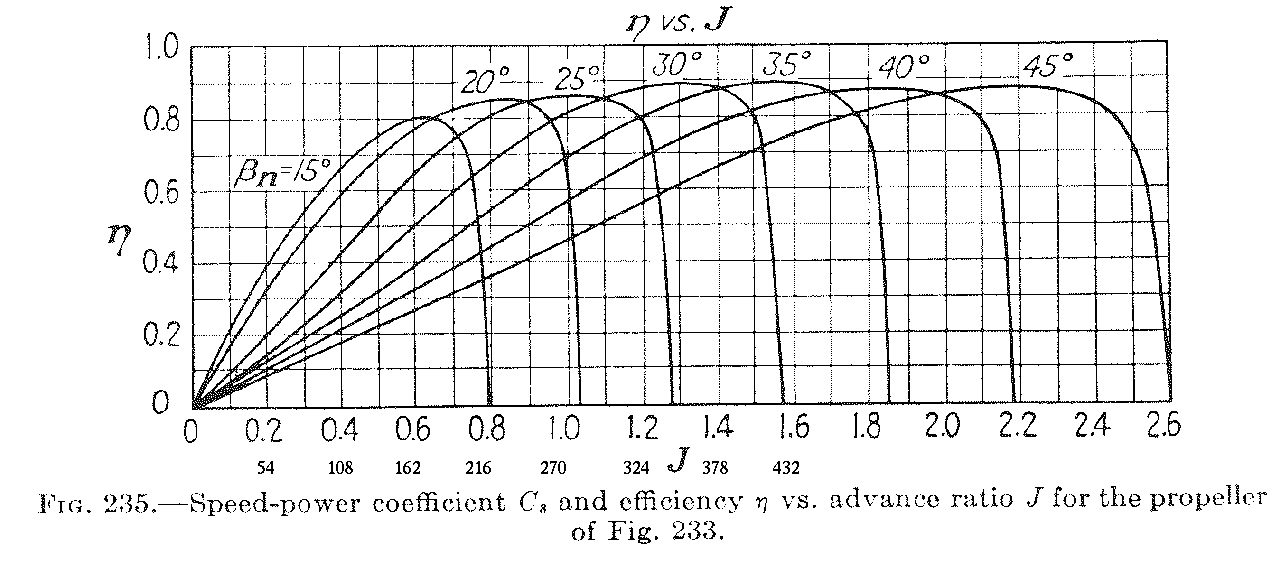
The x axis is J = V/nd where V is the forward
velocity of the airplane and
n is the RPM of the prop while d is the diameter of
the prop.

In our case d is always about the same so J is
proportional to V/RPM.

Each curve is for a different pitch angle setting as
marked.

So Vance, let me get this straight. These are bogus
efficiency curves
for a variable pitch prop. Correct statement?

The curve on the right marked 45 degrees is not the
efficiency curve
for a fixed pitch prop. Correct statement?

Paul Lamar
Since I have no idea where you got these curves, I
could not say - I would expect they are for neither a
constant speed nor a fixed pitch prop but a series of
imaginary props, and were generated by a stack of
differential equations which may or may not be bogus.
These curves cleverly obscure what is going on  in a
real prop, and are not much use in designing a prop
nor
predicting performance, obviously a whole propeller
cannot be at 15, 30, or 45 degrees. The data may or
may not obey the laws of physics - they have made it
difficult to tell - believe what you want - Vance
It is an adjustable pitch propellor.
I got them from Von Mises Theory of Flight and I assume they were
derived experimentally. In other words they measured the HP
out and the HP in. The blade angles are measured at blade r = 3d/8
I am not sure about the twist although I assume it is constant.

BTW n is given in revs per second and not revs per minute.
V is feet per second.

Von Mises uses this formula for calculating thrust in conjunction with
these curves. T = eff. * P/V  where P is HP in pounds feet
per second and V is in feet per second.

I have converted J to FPS for a six foot diameter prop running at 2700 RPM
and added the numbers under the numbers for J. The small numbers are therefore
the aircraft velocity in feet per second. The disk loading
is around 4 to 5 HP per square foot although Von Mises rates this way
way down on the list of important factors for aircraft props. I assume this is
so because as the HP goes up so usually does the diameter and disk area of the prop.
Naturally so does the RPM or RPS go down with diameter. J = V/nd so n times d is
more or less constant over the range for most aircraft props.
Most important is angle of attack as a function of aircraft speed or advance ratio.
Next
is solidity ratio. Number of blades, blade width, etc. He rates exact twist and plan
form as of minor importance.

Paul Lamar

The Aircraft Rotary Engine Newsletter.              Powered by Linux.

http://home.earthlink.net/~rotaryeng/            http://www.linux.org