Vance Jaqua wrote:
difficult to tell - believe what you want - Vance
It is an adjustable pitch propellor.
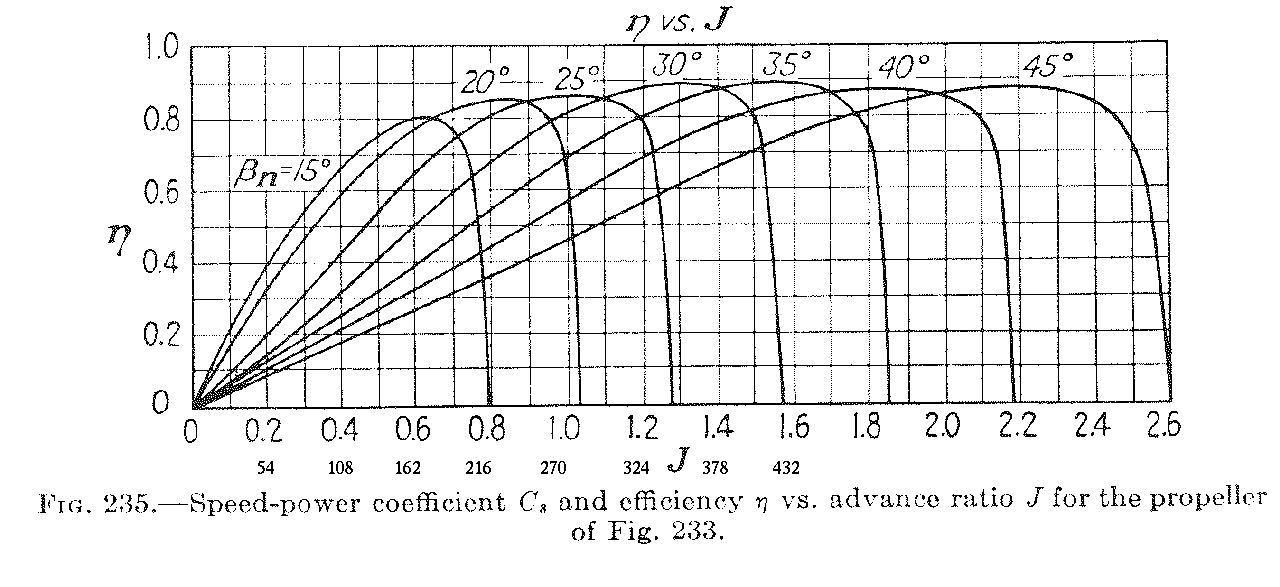
I got them from Von Mises Theory of Flight and I
assume they were
derived experimentally. In other words they measured
the HP
I seriously doubt that -VJ
out and the HP in. The blade angles are measured at
blade r = 3d/8
I am not sure about the twist although I assume it
is constant.
Constant thist would menn they had the wrong pitch
every where else - VJ
BTW n is given in revs per second and not revs per
minute.
V is feet per second.

Von Mises uses this formula for calculating thrust
in conjunction with
these curves. T = eff. * P/V  where P is HP in
pounds feet
per second and V is in feet per second.

I have converted J to FPS for a six foot diameter
prop running at 2700 RPM
and added the numbers under the numbers for J. The
small numbers are therefore
the aircraft velocity in feet per second. The disk
loading
is around 4 to 5 HP per square foot although Von
Mises rates this way
way down on the list of important factors for
aircraft props.
If this is the case why did all the ultralights start
performing after they used reduction drives and droped
dicc loading a bout 4 to 1 ? -VJ
Because it is a two to one or a 100% or more change in disk loading.

100 to 150 HP is from 4 HP per square foot to
5 HP per square foot a 20% change. PL
I assume this is
so because as the HP goes up so usually does the
diameter and disk area of the prop.
Naturally so does the RPM or RPS go down with
diameter. J = V/nd so n times d is
more or less constant over the range for most
aircraft props.
Most important is angle of attack as a function of
aircraft speed or advance ratio.
Next
is solidity ratio. Number of blades, blade width,
etc. He rates exact twist and plan
form as of minor importance.
 Like I have said, most of these curves only work near
the design point, and they ignore the laws of physics
that knocks them off scale when they depart from a
narrow range. I have little respect for this work.
If we listened to these guys the top speed for planes
would still be about 375mph (advertised by phd's in
aero during the mid 30's) and Apollo would still be
just a Greek God instead of a moon shot that is one of
the greatest accomplishments by man in the last
century
-Vance
You are forgetting that an Italian float plane still holds
the worlds sea plane speed record of over 400 MPH set in 1933.

You are about the only one I have ever run in to that
discredits Von Mises. Von Mises is held in high regard in most quarters.

I think you are over emphasizing the disk loading factor.
You show almost no advantage to a constant speed prop
in your charts and I think all who have flown them know better.

I am feeling better so I am off to SZP tomorrow to get some
takeoff data.

BTW that chart I uploaded was limited to a fine
pitch of 15 degrees. I think the high eff. numbers will extend
down to lower speeds if even finer pitch is used. I am going to
check with Tracy Saylor and find out where the fine pitch stops are
set on his constant speed prop. His airplane has remarkable take off and
climb characteristics as well as being the fastest RV6 in the world.

Paul Lamar

The Aircraft Rotary Engine Newsletter.              Powered by Linux.

http://home.earthlink.net/~rotaryeng/            http://www.linux.org