Russell Kent wrote:
I've been pondering the various design goal of the different fuel system
approaches.  I have come up with an idea I haven't seen expressed so far, so I
thought I would throw it out there.

Assumptions:

  1. Aircraft has two equal-sized main fuel tanks (left and right for our
     discussions)
  2. Flights are started with equal amounts of fuel in each tank
  3. A two-rotor engine is used
  4. Backflow check valves exist in the fuel injection pumps (add them otherwise)

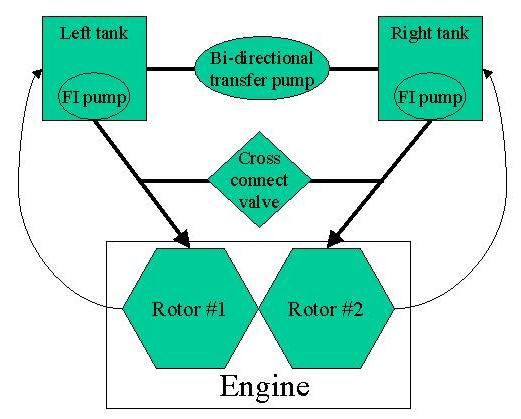
Place one fuel injection pump in each tank.  Run the high pressure lines to the
engine side of the firewall.  Connect the high pressure lines to one straight side
of two "T" junctions.  Connect the non-straight side of the "T" connectors to
opposite sides of a normally-closed solenoid valve.  Continue the straight sides
of the "T" connectors to the separate fuel rail for each rotor.  Using two
pressure regulators (one per rail, which is also one per rotor), plumb the return
back to the corresponding fuel tank, preferably at a distance away from the fuel
injector pump.

Goals met:

  1. Single fuel pump failure cuts fuel to half of engine, but engine keeps
     running.  Energize cross connect valve to pump fuel to both halves of
     engine.  Takeoffs could be made with cross connect valve energized so that
     reaction time is eliminated.
  2. Fuel balancing (in the event of a pump failure or highly uneven consumption)
     is accomplished with the transfer pump.
  3. Excess fuel is returned to the source tank.
  4. Fuel heating is dissipated in the fuel tanks.
  5. No fuel in the passenger compartment.
  6. No fuel tank in the engine compartment.
  7. No single failure will kill the engine.
  8. Double failures (other than both fuel injection pumps) will not kill the
     engine.
  9. Fuel pickup uncovering, being opposite in each tank, should only cause half
     the engine to stop.  Less likely to suffer fuel starvation engine failure in
     uncoordinated turns (such as when landing).  [Those of you from the "landings
     should be made with no power" school just be quiet.  :-) ]
 10. Nearly zero pilot attention required.  No fuel tank selector  :-)
 11. No multiport fuel source/return selector valve(s)
 12. Running a fuel tank empty causes half the engine to stop.  Pilot now has very
     few minutes to find a spot to land at.  (Presumption is that the remaining
     tank is close to empty.)

Fuel system startup test could be:

  1. Start engine.
  2. Pull breaker on left fuel injection pump, observe RPM drop, reset breaker
  3. Pull breaker on right fuel injection pump, observe RPM drop, reset breaker
  4. Engage cross connect valve
  5. Pull breaker on left fuel pump, no RPM drop should occur, reset breaker.
  6. Pull breaker on right fuel pump, no RPM drop should occur, reset breaker.
  7. Disengage cross connect valve
  8. Set transfer pump "To left, from right", listen for whine/gurgle or watch
     fuel flow gauge
  9. Set transfer pump "To right, from left", listen for whine/gurgle or watch
     fuel flow gauge
 10. Turn off transfer pump, engage cross connect valve, ready for takeoff.

Disadvantages:
a. Additional pressure regulator
b. Must separate the fuel rails for the rotors
c. Intentional asymmetric fuel loadings (for W&B purposes) may require management
of transfer pump

Other notes:
Fuel consumption _by_rotor_ from the engine controller would be really useful.
Might need to get Tracy's help with an EC2.

Russell Kent
The Aircraft Rotary Engine Newsletter.              Powered by Linux.

http://home.earthlink.net/~rotaryeng/            http://www.linux.org