Russell Kent wrote:
Marc Mularz wrote:
Paul:
What is a stratified charge? Thanks, Marc M
Marc,
The short answer is a fuel and air mixture that is not uniformly mixed (not
"homogeneous").

The long answer is a fuel and air mixture that has a localized rich mixture
near the ignition point (spark plug) and a leaner mixture elsewhere.  The
idea is that the localized mixture is rich enough that the spark plug will
ignite it, but that the overall charge is too lean to be ignited with the
spark plug.  The rich mixture flame front ignites the lean mixture.  This
allows very complete combustion (excess oxygen does that), giving maximum
energy from the fuel and lower BSFC values.

The trick with stratified charges is getting the localized rich mixture
near the spark plug at the time when you want the spark plug to fire, which
is why Paul said:
Timing between the squirts [of the main and pilot injectors] was
critical.
Another downside with stratified charges is the exhaust gases (CO, NOx,
VOCs) can vary all over the map depending on the combustion environment.
Emission control depends on a fairly adept engine controller with lots of
sensors (MAP, air mass flow, O2, ...).  Of course, emission controls are
not an issue with airplane engines.  :-)

Paul also wrote:
The term stratified charge came from the fact that most of the charge was
pure air.
Uh, not precisely correct.  All engine charges are mostly air.  Stratified
charges are purposely non-homogeneous (they have "stratification layers" or
"regions"), which is where they get their name.  The majority of the charge
is very lean, but not neccessarily "pure air."
In a normal rotary the charge is more or less a uniform mixture of fuel
and air provided at the side intake port.
True.  Again, what makes a "stratified charge" engine is that the fuel and
air mixture is purposely non-homogeneous.
This all should be reconsidered in the light of recent developments in
the area of extremely high pressure electronic injectors as used by Ford
diesel trucks  and OMC outboards and of course modern computers.
Eh?  Name *one* modern computer that uses "extremely high pressure
electronic injectors" :-)

Russell "Smart ass to the end" Kent
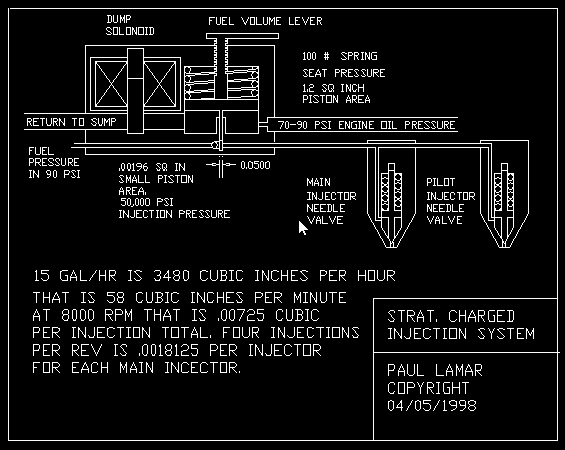
I just mentioned two. Try 20,000 psi. The Ford electronic diesel
injection system  uses engine oil pressure to enhance the fuel pressure
in each injector.

This drawing is similar to to the Ford system except everything is built
into the Ford injector as one unit. This also won't work for a strate charge
rotary as the timing for the pilot injector is wrong.

I took some photos of the Ford injector at the Detroit auto show and I
have them around here someplace. The Ford system has been around for
at least three years and the OMC system is just now available on outboards.

In the case of the OMC
there is a high speed electronic pulse pump in each injector that
jacks up the 40-90 psi pressure from the fuel pump and supply rail.
This is used in a direct injection two cycle gas engine built by OMC.
In fact it is the technology of choice to meet emissions and improve
the fuel burn of two cycle outboard motors.

BTW direct injection is defined as fuel injection directly into the
combustion chamber usually after the air is compressed.

Paul Lamar

The Aircraft Rotary Engine Newsletter.              Powered by Linux.

http://home.earthlink.net/~rotaryeng/            http://www.linux.org