FWIW, consider this as an additional data point on the prop shaft
diameter
discussion. The prop shaft on my Rotax "B" version reduction drive
is right
around 7/8" diameter and has been spinning a 3 blade 66" prop for
about 750
hours. There are a LOT of these redrives out there and I do not know
of any
failures.  None of them are turning metal props as far as I know.

Tracy Crook
rws@altavista.net
www.rotaryaviation.com
Tracy,

What weight prop and what HP?  Both are critical.  With a low HP wood
or foam core composite, both the torque and gyro loads would be very
much
lower than with a wooden higher HP prop (large blade chord increase for
more
HP) and especially for a fixed metal or worse, a conventional constant
speed
prop. If the Rotax is a 50 hp unit and the prop has extremely light
blades,
7/8" may well be fine, exp if no acro is done.

Bill
How about stalls and turbulence? Flexibly blade IVO props help too.

Paul Lamar
To give a more accurate account, the first 500 hours on my Rotax powered
TwinStar were with a wood two blade prop weighing about 6 1/2 pounds. The
following 250 hours were with a 3 blade IVO at 7 1/2 pounds.  My brother
flies a similar plane & engine with a 3 blade Warp Drive.  This prop weighs
about 12 pounds (more than the wood prop on my RV-4 at 11 lbs  !).   My seat
of the pants analysis says that the prop shaft of the Rotax has higher
stress than my redrive prop shaft.

 I did limited acro in the Twinstar but got more cautious in life after a
year of getting away with this.  The worry was with the airframe, not the
prop shaft though).   Ultralights (and similar planes like the two place
Twinstar) spend a much higher percentage of their time doing turns and other
maneuvers when compared to planes like my RV-4.  I would think this would
give the prop shaft a relatively worse life.  And when it comes to
turbulence,  the ultralights have a MUCH rougher go of it.  Fly one and see.
I still remember the flight that inspired me to order the RV-4.  It was a
100 mile flight from Ocala to Clearwater with a 40 MPH headwind and rough
air.  Took 5 hours and when it was over my arm was aching from the effort of
controlling the plane.

Tracy Crook
rws@altavista.net
www.rotaryaviation.com
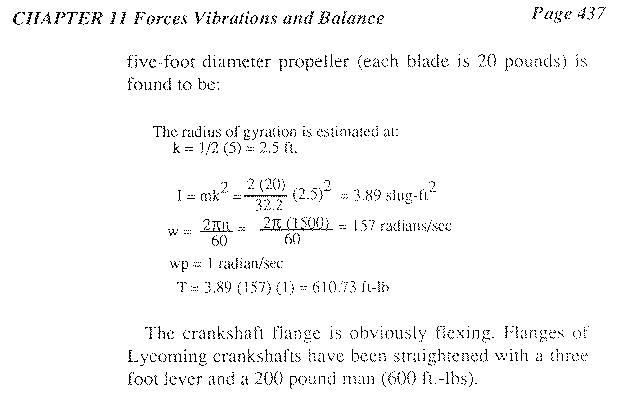
No need for guessing. Here is a page from a great low cost ($25) book called
the Sky Ranch Engineering Manual. 916 421 7672. Change the weights of the
blades of course.

I have researched this and it appears
there is a consensus on about one radian per second or about 60 degrees
per second. One would get pitch change like this in a stall or turbulence.
Don't forget to add torque and thrust to the gyro loads. VW engines used in AC have
had a lot of problems with this.

Some mention has
been made on here that a two blade prop is worse than a three blade prop as the
gyro loads change twice per prop rev. This sounds plausible to me.
If so this is very conducive to fatigue.

Aerobatics would be much worse of course.

I would like to motorize your test stand for pitch change Tracy and test
our CS prop design as well as your prototype PSRU. I assume it is still on your
test stand. If you don't mind.

Paul Lamar


The Aircraft Rotary Engine Newsletter.              Powered by Linux.

http://home.earthlink.net/~rotaryeng/            http://www.linux.org