Paul wrote:
Perry,
I choose steel for the prop hub sleeve for several reasons. The coeff
of thermal expansion is lower than aluminum and epoxy bonds to it
better than aluminum. It is also closer to carbon epoxy on
the atomic scale so galvanic corrosion should be less I think.
The area of the coupling in contact with the epoxy/carbon
fiber is about 19 square inches not counting the sign wave
surface. That is just a simple calculation based on the OD
and length of the sleeve. If the tensile load is 20,000 pounds
the shear load between the carbon fiber/epoxy and the steel
would be about 1000 psi which is in the range of epoxy adhesive.
The sine wave surface should help as it should act as a mechanical
lock not to mention the increased bond surface area.

I suggest putting a peel ply over the hub area when laying up
the first surface. Than place some plastic sheeting over that and
wrap large rubber bands around the hub sleeve to positively
keep the carbon/epoxy in contact with the sine wave surface
of the coupling until the top cures. After the bottom is laid
up the same thing can be done. When the bottom is cured the
peel ply can be removed and a tensile wrap of continuos fibers
can be applied over the steel hub to lock everything together.

Paul Lamar
Who is machining the metal parts?  Maybe this was mentioned but
I didn't catch it.  I was hoping my "price" for building the blades
would be a free kit of the metal parts that I couldn't make myself.
But I've already had an offer of financial assistance also.

When would the hub sleeves be available?  I could work on the mold
in the meantime.  Also, you spec'ed 200mph twist, what diameter and
chord distribution?  Conventional props are different than the fans
I've made so far, which were constant chord (the wood props) and
linear chord taper (the carbon prop).  May be best to get some
measurements from a typical prop (maybe a Klaus prop?), I can run
them through my program to get a good predictor of performance.
--
Perry J. Mick
Mick Duckt N7XR
http://www.mickaircraft.com/duckt.htm
John Moran mentioned he might have them done by Sun & Fun but I thought
that a bit soon. I would like the first article to be for ground
test only. No telling what problems might crop up demanding a design
change.

Klaus is not about to give out that info but I will ask him anyway
when I get back from shady Bend next week. BTW I will be leaving on
Tuesday tomorrow morning so hold all messages until a week from today.

In the mean time if you are real hot to get started you could try
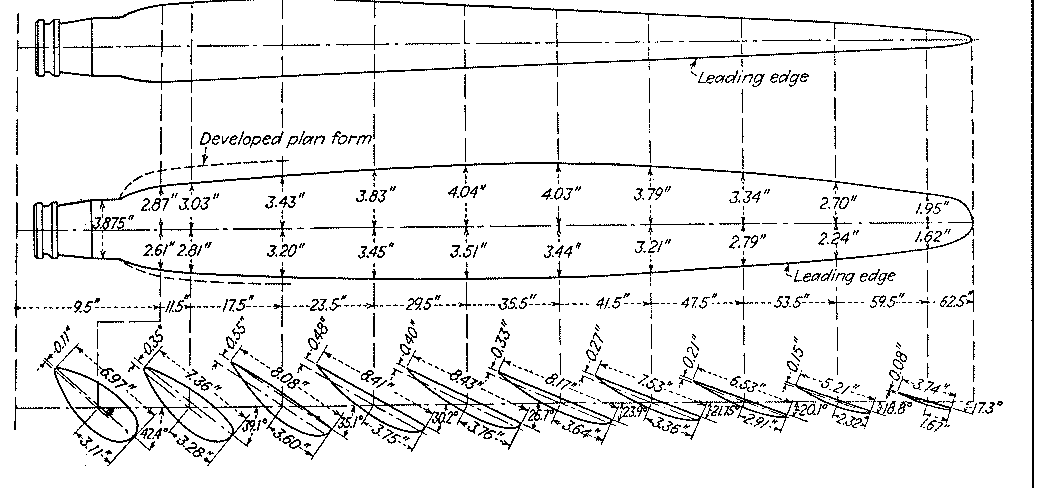
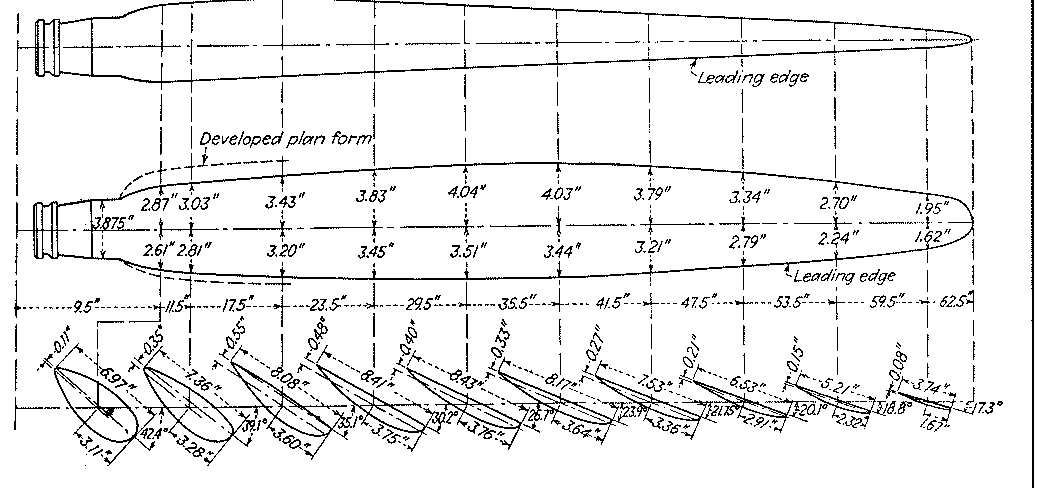
the old classic prop planform and twist shown here. Tried and true :-)

Six feet ought to be about right but 66 inches would also work.
What size props are you RV guys running?

Paul Lamar

The Aircraft Rotary Engine Newsletter.              Powered by Linux.

http://home.earthlink.net/~rotaryeng/            http://www.linux.org