Perry Mick wrote:
Paul:

Peter Cowan has kindly donated $100 towards materials for the
CS prop blades.  Other donations would be welcome.  I will donate
my time.  I can't see the cost of materials exceeding $300 so any
excess donations I would forward to your race fund.

I've been playing around with a 68 inch diameter prop twisted for
75 inch pitch at "0" degrees of rotation.  Assuming a constant 150
HP, here are some results:

        speed, knots
blade   for 150HP       actual HP       Thrust          Prop Efficiency
angle   @2800 RPM
-5      10              150.2862        594.8937        0.121473
-4      80              148.6547        469.0335        0.774597
-3      100             150.166         414.1032        0.846248
-2      120             144.8881        352.9075        0.896954
-1      130             149.4755        340.9437        0.909948
0       140             153.7152        328.9666        0.919441
1       150             157.6523        317.5427        0.927158
2       170             138.9872        250.9947        0.942105
3       180             141.0632        241.4703        0.945547
4       190             143.3405        233.0989        0.948169
5       200             145.9712        225.9701        0.950111
6       210             149.115         220.1647        0.951494
7       220             152.9388        215.7559        0.95242
8       230             157.6159        212.8104        0.952975
9       240             163.3254        211.3881        0.953232

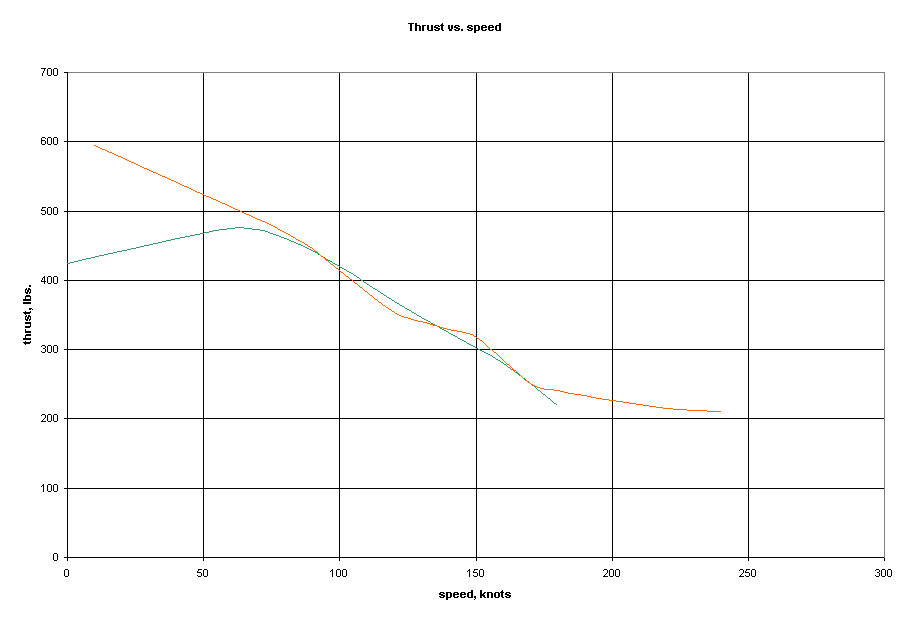
and here is data assuming the same prop with pitch fixed at the
0 degree location:

assumes constant 150HP (which means performance is actually worse
at the low speed end and better at the high speed end.

speed,
knots   rpm     thrust
0       2350    425
60      2500    475
80      2520    460
100     2580    420
120     2660    370
140     2780    325
160     2930    280
180     3120    220

The plot tells the story better than the numbers. I'm getting this
effect at high rotation angles of the blades, +4 to +9 degrees, where
the things seems to want to keep going, i.e., I keep increasing the
blade angle and keep getting more thrust at higher speed, thrust is
not going to 0. The thrust curve is flattening out.  Is this real?
Vance????
The data for the CS jumps around because the program does an analysis
every 10 knots, and I just picked the results in each case closest to
150 HP.


Perry J. Mick
Mick Duckt N7XR
http://www.mickaircraft.com/duckt.htm
Looks good Perry.
BTW keep the thickness up for the first half of the radius to maintain torsional
stiffness. I think that is one mistake IVO makes.

Also if you do make a female mold you can fill the prop after the front
and back is glued together with syntactic foam. (Foam made by mixing micro balloons
with epoxy). Experiment with ratios and resins to keep the viscosity down.
I don't have any strength data but I suspect it is stronger than most
of the blown foams.

A centrifugal casting arrangement might help in getting the syntactic foam
all the way out in the blade. I think this is the trick that IVO uses
but his blade design is too thin and the fiber glass skins are too thin to develop
much torsional and bending stiffness.

Paul Lamar

The Aircraft Rotary Engine Newsletter.              Powered by Linux.

http://home.earthlink.net/~rotaryeng/            http://www.linux.org