Hi Paul,
Seems like a lot of us nubies and semi-nubies don't
quite know the HP/RPM/Torque/Thrust.....et al power
potential of the 13-B engine in different configurations
ie: Naturally aspirated, fuel injected, peripheral
ported, turbo charged etc. etc..
A data sheet/spread sheet with all these specifications
would be fabulous to have, after all you are a walking
encyclopedia and posses all this wonderful knowledge in
your head.
                               Thank You
                             Butch Diaz Sr.
Here is my estimates for a short list. All at 6000 RPM
and fuel injected.

13B NA side ports with well done intake and exhaust           180 HP
13B NA peripheral ports well done intake and exhaust      210-240 HP
13B turbo (how much do you want?:-)                 up to     400 HP
For the three rotor multiply all these numbers by 1.5.

Now if you want to run the engines faster, say up to 8500 RPM
You can multiply these numbers again by 1.4.

The big question is; how much can you get for long term cruise?
Tracy thinks 200 HP for a 13B. I think more like 250 HP if
the cooling system is done right and 2 cycle oil is used to lube
the apex seals. Maybe a bit more with ceramic apex seals. Mazda was
able to get about 345 HP (WOT) from two rotors NA for 24 hours at Lemans
with the following RPM schedule. There was very little wear at the end of the
24 hours with no reduction in max HP or increase in fuel burn.

Mazda won the race overall. The next year they were outlawed of course.
The Europeans could not let them win from then on. The entire
auto engine manufacturing infrastructure of europe would have to
retool and make rotary engines :-)

*NA stands for normally aspirated.

Paul Lamar
Russell Kent wrote:
Paul,
For some reason I was thinking that the LeMans winner was a 4-rotor with
adjustable length intake runners (to tune the intake to different RPMs).  Where
have I gone wrong?

Russell Kent
Right here Russell :-)

"able to get about 345 HP (WOT) >>>> from two rotors <<<

Yes it was a four rotor engine.

What has "adjustable length intake runners" got to do with it?
If you fixed the variable length pipes at 22 inches or so you you would
get 240 HP at 6000 RPM. FROM TWO ROTORS!!!!

Race prep on a rotary is mainly a question of porting. No other work is required
such as forged 4340 crankshafts or rods and pistons. None of that is necessary
so the term race prep for a rotary aircraft engine is meaningless. Besides almost
nobody with the possible exception of the gyro guys are running rotary aircraft
engines faster than about 6000 RPM which for a rotary capable of 9000 RPM is loafing.

Come on guys be positive. Get with it and do it right.

Allan Tolle was flying his PS peripheral port rotary powered RV across the country
from CA to FL and then running 230 MPH in the Sun 100 years ago. IMHO despite his
great
success the cooling system  was still not the best it could be.

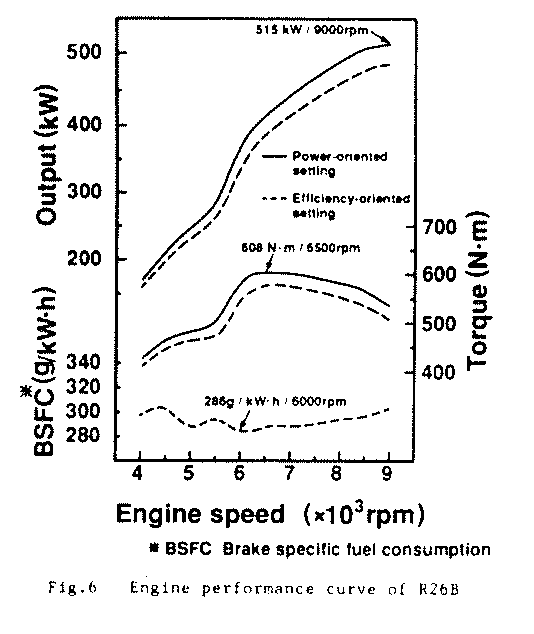
The following is the HP chart from the Lemans engines.
One HP is 746 watts so divide 515,000 by 746 to get HP or 690 HP for FOUR ROTORS.
Note the dip in fuel burn at 5000 RPM for this peripheral port engine.
BTW these were sewer pipe intakes at around 2 to 2-1/4 inch in diameter.

Paul Lamar

The Aircraft Rotary Engine Newsletter.              Powered by Linux.

http://home.earthlink.net/~rotaryeng/            http://www.linux.org