Peter Cowan/Lexi Cameron wrote:

One of my obsessions is achieving the best take off performance for short field or
floats. Is there any formula that takes into account wing loading, span loading,
power loading (and any other identifiable design measurements) to come up with a
number that would allow comparisons between different designs?

For example we have seen the Rebel beat a super Cub off the water at S n F and
heard that the Glasstar will beat both of them (although they have declined a
competition). It would be neat to plug in the above or other variables to be able
to predict which one would be best.

Any ideas?
Thanks, Peter
I don't know of one. I suggest a book called "A Practical Guide to Airplane
Performance"
published by the author Donald R. Crawford (310) 373 9277 in Torrance CA.

Things to look for are prop diameter, power to weight ratio and wing loading.
Span loading is not too important because speed is low. More important when
it comes to climb speeds.

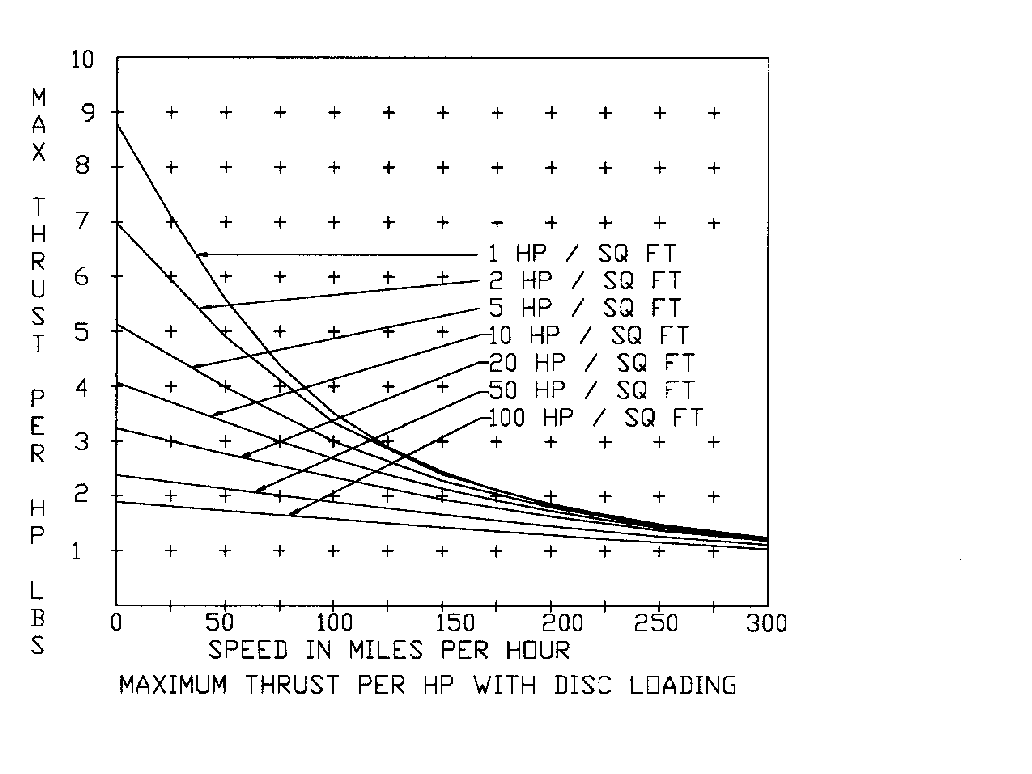
A large diameter low RPM prop implies good static thrust. (Helicopters)

BTW the real number is HP per square foot of prop area so twin engines
usually come out better in this calculation.

See Vance's chart below.

Multi-blade props also improve static and climb thrust at the expense of worse
high speed efficiency.

High power to weight ratio means good acceleration and the ability to
quickly get up on the planing step in a sea plane.

Low wing loading implies low stall speed and consequently low lift off speed
again at the expense of top and cruise speeds. Moderate flaps help of course.

Hull and pontoon shape are also important factors with seaplanes.
Sponsoons(s?) trap air underneath reducing water drag and allowing
the airplane to take off quicker.

Paul Lamar

The Aircraft Rotary Engine Newsletter.              Powered by Linux.

http://home.earthlink.net/~rotaryeng/            http://www.linux.org