"Rogers, Bob J." wrote:
In an earlier message about the size of intake manifolds you said:

                " Probably easier to make a peripheral port and be done with
it :-).

                In any event these tube sizes are pathetic for a NA rotary.
                We should be running 2-1/4 or 2-1/2 inch  tubes with
peripheral
                ports for NA engines.  Again, one tube has less skin
friction
                than two of the same area not to mention the fact they have
greater
                total area. Turbos matter less as you just crank up the
boost
                a bit.

                Let me know what you guys want to do. All comments highly
appreciated
                on these tube sizes.

                Paul Lamar"
Please set your email program so it does not do this^^^^
The Racing Beat catalog offers Peripheral Port rotor housings for racing
applications.  Although they do not say how large the intake ports are, the
Weber 51 IDA Racing Carburetors that they offer to fit on their N.A.
peripheral port engines have various venturi sizes, ranging from 36mm to 46
mm in diameter (or 1.4 to 1.8 inches).  In other literature, the race engine
is described as one that makes great power at 9,000 RPM, but won't run below
4,000.
That is an exaggeration on Jim's part and he knows it. Perhaps with Carbs.
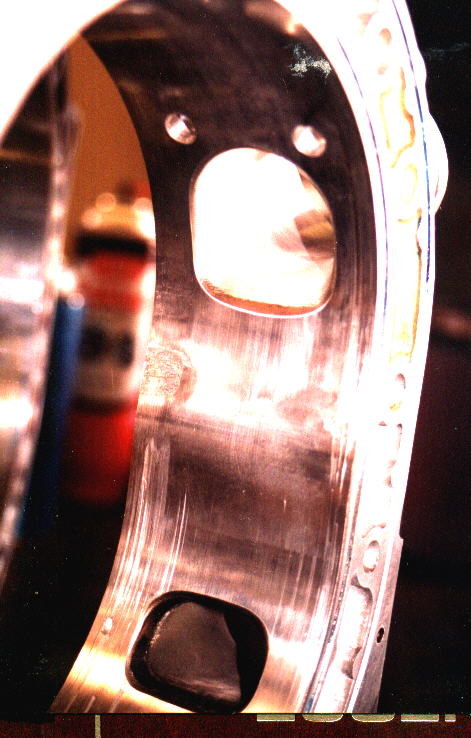
That was also written years ago and Jim is now using at least 2.5 inch
or larger pipes. See the picture below of the rotor housing on his
900 HP turbo three rotor.
On his web page, Paul Yaw states, " Velocity alone determines at what rpm
peak torque and horsepower will occur for a given intake and exhaust
duration.
This is totally untrue. What matters is the total mass of air entering
the engine and staying there and this is a function of both velocity,
pipe size, tuning and port timing.
(Duration is the amount of time that the ports are open.) As most
readers know, the intake port on a rotary engine closes well after bottom
dead center.(BDC)
What this means, is that the rotor is starting to compress
the mixture while the port is still open. When velocity is low, some of the
mixture will be
squeezed back into the intake manifold. If velocity is high, the inertia of
the incoming
mixture will overcome the rising pressure of the chamber, and continue to
pack mixture
into the engine well after bdc. This effect is called inertial
supercharging..."

Since we are looking at RPMs in the range of 5,000 to 6,500 at cruise for
our aircraft applications of the rotary, and the largest diameter intake
opening that Racing Beat offers for its Peripheral Port racing engines is
only 1.8 inches per tube (which is presumably for engines that will make
peak power at 9,000 RPM), and since velocity of the airflow is crucial for
determining peak power, don't you think that 2 1/4 or 2 1/2 inch diameter
intake pipes for a N.A.  peripheral port engine are too large?  It seems to
me that such large intakes would kill the airflow velocity at the lower RPM
range of 5,000 to 6,500 for aircraft cruise applications.
As I said before air velocity is not everything.
Look at the ACRE NL and see the drawing of a peripheral port modification and
make your own.
What would be the optimum size diameter intake tubes for a N.A. peripheral
port engine running at 6,000 RPM?  Powersport claims to be making 210 HP at
5,610 rpm with their N.A. peripherial port engine.  What size are the tubes
for their intake manifold?
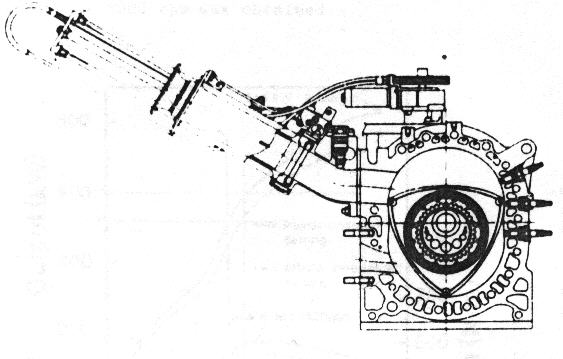
Scale this drawing of the Lemans winning NA engine and copy it exactly
and you will get 230-240 HP at 6000 RPM. If it did not run
below 4000 RPM it never would have won the race.

I am not sure about the PS pipes but I would guess them to be 2" to 2 1/4".

For a lot more information on this get the CD and read up on it.
In there you will find HP curves for the Lemans winning engine and you can
see for yourself.

Paul Lamar

The Aircraft Rotary Engine Newsletter.              Powered by Linux.

http://home.earthlink.net/~rotaryeng/            http://www.linux.org