DENIS SMITH wrote:
They are on the inlet side of the fan and on the
outside of the duct.  As the fan seeks to grab more
air at low speeds (less ram air available) the spring
loaded doors get sucked open allowing more air to be
sucked into the inlet.  Really effective for takeoff
and low speed power.
Obviously the B52 ducts are basically  designed for high speed so I am
not sure that trick would work in a low power, low speed  system like Perry's.

What Perry needs is a really BIG bell mouth for real low speed
thrust and acceleration and to redesign his basic ducts for 200 MPH.
He will also need a lot more power and that means getting the
engine up to 7500 RPM from 5000 RPM with more or less the same fan speed.
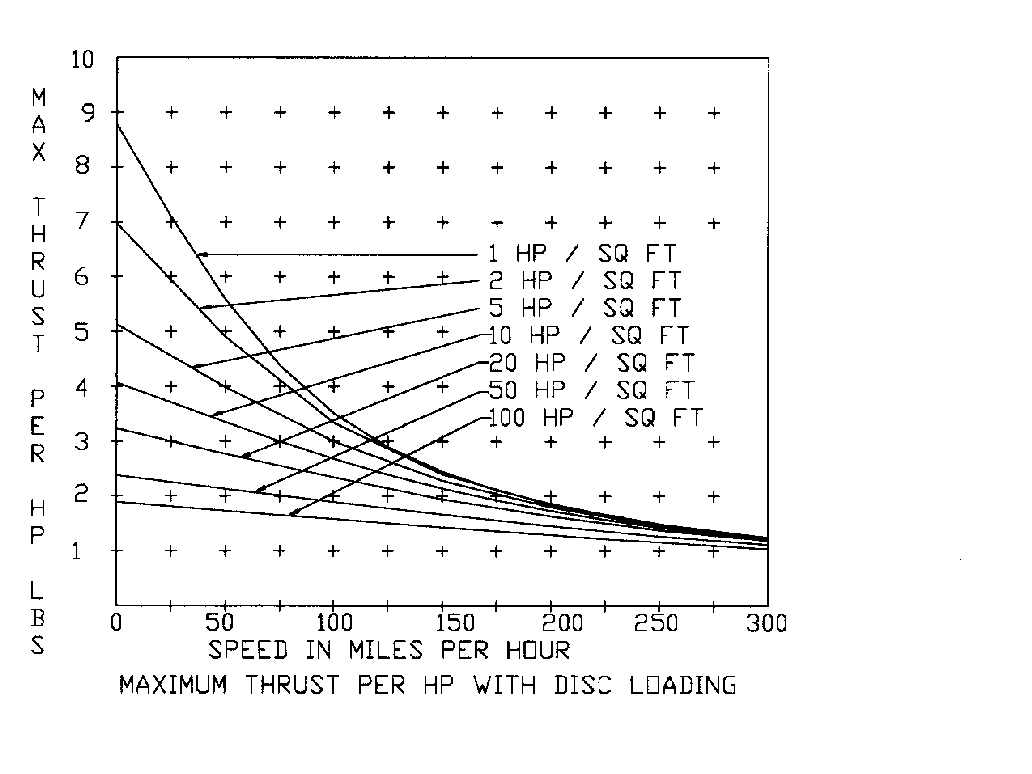
That in turn means a gear box to maintain any reasonable sized
ducted fan with half way decent efficiency at these
high fan disk loadings. See the chart.

If on the other hand he had a high speed airplane design and a turbo
three rotor with 900 HP or so he could probably sacrifice fan takeoff
efficiency (or use the B52 trick) and go 350 to 400 MPH.
The point is if you have enough HP to go 350 or 400 MPH you will have
enough low speed thrust to get off the ground sort of. Much like earlier
low powered jets.

Even Pratt & Whitney and GE are considering
gearing the fans in the large turbo fans used in airliners.
Garret already has geared turbo fans installed in business jets.

Also, with any direct drive Mazda engine you must consider the thrust
loads on the e-shaft. The Mazda thrust bearing is not up to prop
thrust loads.

BTW I always hate to be the bearer of bad tidings.
Back in Roman times they used to execute the messenger bringing
bad news. Seems like a good idea to me.

Paul Lamar

The Aircraft Rotary Engine Newsletter.              Powered by Linux.

http://home.earthlink.net/~rotaryeng/            http://www.linux.org