Tracy Crook wrote:
Yes, you will have to pay closer attention to cooling system at 250 HP but
basics never change.  Cavitation in a centrifugal pump (which is what we are
using) is more likely with less restriction on the outlet.  This has been
proven time and time again in open or closed systems.  If someone can prove
me wrong on this, please do so. Basics like this are important when trying
to diagnose  cooling system problems.
snips..
Tracy Crook
rws@altavista.net
www.rotaryaviation.com
You do agree that blocking the output completely will cause cavitation
at any RPM don't you? :-) You will also agree that the max flow is a function
of the size of the pipe I am sure. Well then, what is the minimum size of the
outlet as a function of RPM that will not result in cavitation?

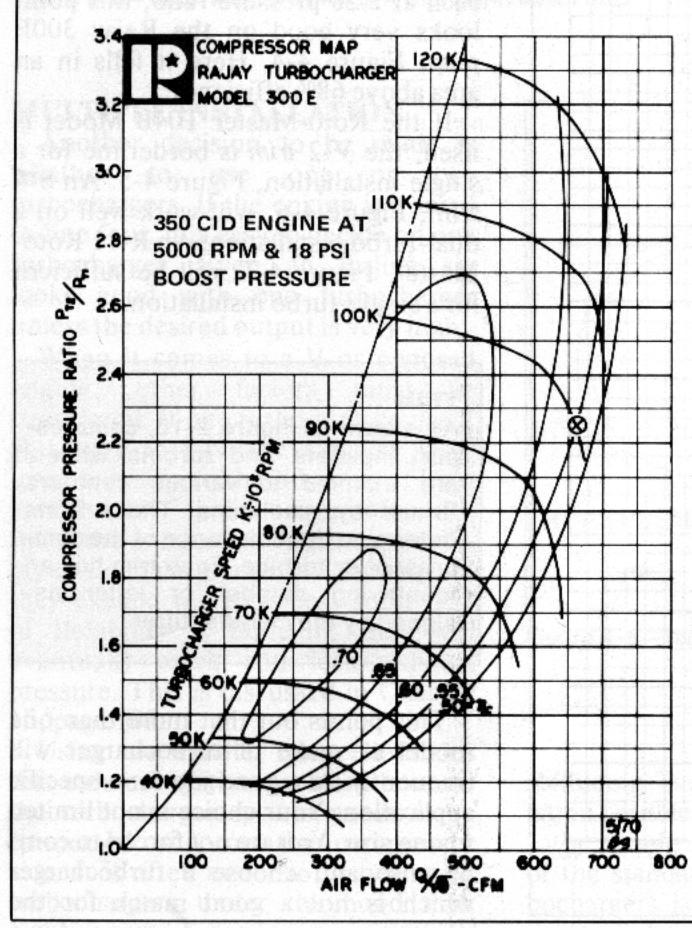
This is a turbo compressor map. Note that when the flow is zero the
RPM matters not and the cavitation RPM goes down as the flow goes
down. I don't have a map for a centrifugal water pump but I will bet
it is similar.

I think you are getting engine water pump flow mixed up with
a non positive drive electric pump where the RPM of the pump is a
function of the flow and pressure. In our case the pump is driven by
the engine at a fixed speed regardless of the flow and pressure.

Paul Lamar

The Aircraft Rotary Engine Newsletter.              Powered by Linux.

http://home.earthlink.net/~rotaryeng/            http://www.linux.org