George Lendich wrote:
OK Paul,
I'm not up to speed on 'Turbo Compound' can you tell me what it is.

Also thanks for the info on the C6, it does help a lot !!

George (down under)
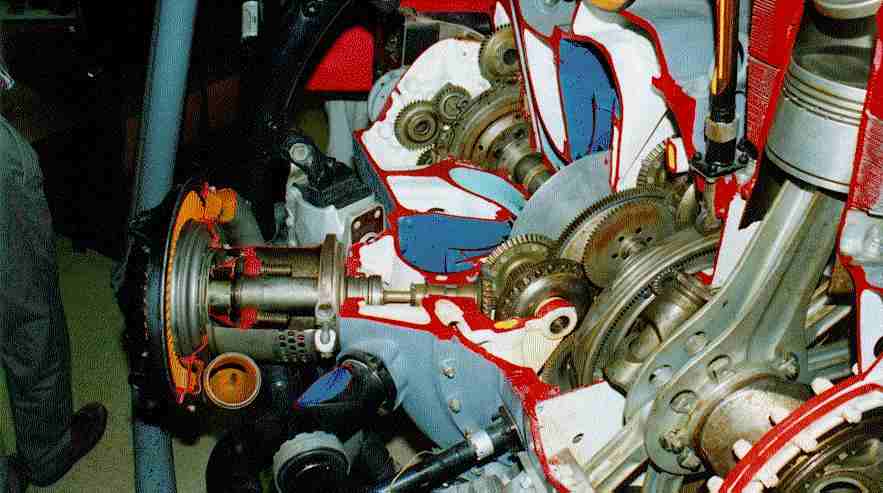
Excerpts from the ACRE NL web site plus a picture Bill Freeman
took of an actual cut a way CW R3350-TC. The orange thing on the left is
the exhaust turbine feeding power back into the crankshaft.


HISTORY OF TURBO COMPONDING
The worlds record prior to the Rutan Voyager for unrefueled distance was
held by a P2V that flew from Australia to Ohio. That airplane used the R3350
turbo compound which had a BSFC of 0.38. Super G Connies with this engine
were able to fly non-stop LA to London over the pole in the 1950's.


BUILDING A TURBO COMPOUND
I had an idea on how to implement a turbo compound arrangement using a gear
box out of a Paxton Centrifugal supercharger. The HP, gear reduction and RPM
is about right for hooking a turbine and feeding the power back into the
engine instead of removing it. Hopefully we will get 20% more power with no
more fuel and no additional load on the engine cooling system.

The rotary has a lot of waste energy in the exhaust that could be put to
good use. Perhaps some additional air could be pumped into the exhaust
system before the turbine to burn the waste hydro carbons. The fact of the
matter is you can get more energy out of the exhaust than you really need
for supercharging. That is why the BSFC goes down on a turbo compound as
opposed to merely just turbo charging.

This is sort of an exponential effect so the real HP limit is the detonation
and structural strength of the core engine. And here is where the rotary
engine scores big time.  The structural strength to weight ratio is
exceptional.  I also suspect the otherwise bad surface to volume ratio of
the rotary combustion chamber is an asset at high boost levels.

The thing to remember is there is always as much or more potential HP in the
exhaust as there is available from the output shaft. The more you pump it up
the more HP is available to pump it up. Since you don't need all the HP in
the exhaust for supercharging the sky appears to be the limit. This excess
exhaust HP fed back into the shaft will result in better and better BSFC.
The beauty of this HP is it does not add to the thermal load on the engine.

The big question is; how much can you get and for how long before the engine
starts coming apart? I would monitor the metal content in the oil, the
rotor housing metal and turbine inlet temperature very very carefully. I
would not rely on coolant temperature alone. Perhaps use a bore scope from
time to time to look into the housing and see if the oil is coking on the
surface of the housing. The other thing I would do is find a knock sensor
that would work.

My compound setup for the rotary would use one Inconel blow down turbine
feeding power into the eccentric shaft and an optional centrifugal blower
using modern aerodynamics either from a turbocharger impeller, an off the
shelf gear driven supercharger (there are several on the market) or a late
model gear or ball driven Paxton taking energy out of the eccentric shaft
to supercharge the engine. To get the full altitude benefit you would have
to fabricate a variable speed drive for the centrifugal supercharger as
well.

We will start with just a one speed blower with a gear ratio that peaks the
boost to what the engine will stand at sea level and at an e-shaft RPM of
6000. That e-shaft RPM assumes you are using a PSRU with a 2.2:1 ratio.

ATI manufactures a centrifugal supercharger the gearbox of which is a
candidate for my turbo compound scheme. They also have some nice looking
water to air heat exchangers if someone wants to go that route for their
inter cooled turbo rotary aircraft engine.

If you just want to fly without a supercharger and you can live with 20%
more power and a 20% lower BSFC at that power at sea level you can forget
the supercharger and the inter cooler and go with just the blow down turbine.

VARIABLE SPEED EVERYTHING
The full whammy is variable ratio gear supercharger with inter cooler for
altitude and variable ratio geared blow down turbine for a lower BSFC. This
is several steps above the 20% more efficient 1950's R3350TC by the way, as
it only had a two speed centrifugal blower (no inter cooler) and a fixed gear
ratio blow down turbine. A variable ratio drive can be made from a wide V
belt and movable flange pulleys controlled by a linear electric servo and a
computer

See the web site for more info.
http://home.earthlink.net/~rotaryeng/


Paul Lamar

The Aircraft Rotary Engine Newsletter.              Powered by Linux.

http://home.earthlink.net/~rotaryeng/            http://www.linux.org