Paul,

Here is an article on centr pump cavitation.  It says
that discharge cavitation can occur but 90% is suction
cavitation.

Bill

PS   it was found at

 http://www.buckeyepumps.com/Cavitation.htm

So it is "discharge cavitation" intead of stall.

We are finally getting some place here.

Note that this is an open loop system the author is talking about here.

Restricting the output of the pump so the inflow can keep up will reduce
SUCTION side cavitation.

In our case the inflow and the out flow are always the same so we are likely
getting DISCHARGE cavitation at high RPM because of the restriction on the output
side. We will always have some restriction due to the block, rad, etc., etc..

I think I will mock up my cooling system on the dyno test stand and use a
couple of pressure gages. One on either side of the pump to see what is going on.

Thanks Bill.

Paul Lamar

CAVITATION

                     for the Technologically Challenged

 Haven't you ever wished you could pick up a technical article that had to do with
pumps that would
 not concentrate on the theory of fluid in motion but rather give you hands-on ways
to determine if
 you have a problem or not? Find the solution. Get on with your life. Well . . . this
is an attempt at
 giving our customers information which would actually help them make money and avoid
excess
 theory.
snips...
 DISCHARGE SIDE CAVITATION is a restriction on the discharge side of the pump system
 which constricts the flow out of the pump. Since liquid can't escape, due to
discharge side
 restrictions, it is recirculated in the pump casing, damaging the outer edge of the
impeller and
 casing or casing ring if there is one.
snips...
                HOW DO I PROVE MY PUMP IS CAVITATING?

 Beyond the obvious and characteristic noise which we described and the erratic
discharge pressure
 gauge, an inspection of the impeller in a centrifugal pump will also reveal the
affects of cavitation.
snips.....
If you have damage around
the outer
 diameter of the pump impeller, and in the casing, you probably have discharge
cavitation.
BINGO BINGO BINGO BINGO !!!!!!!!!!!!
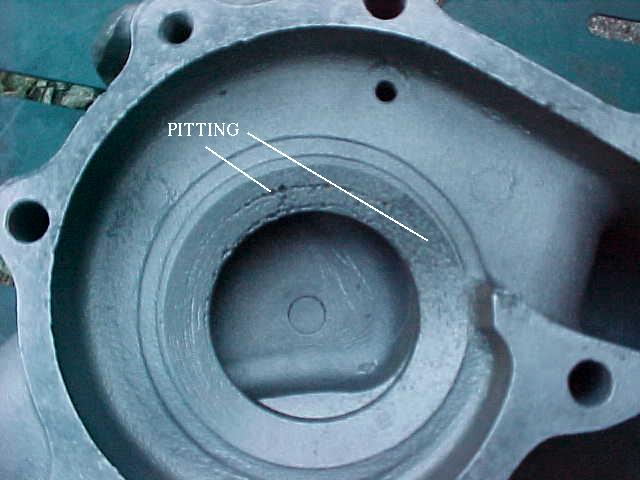
Here is a picture of my pump.

Note the pitting in the casing!!!!

I am already on the right road to fixing this.

Check your pump Tracy and everybody else.

Paul Lamar

The Aircraft Rotary Engine Newsletter.              Powered by Linux.

http://home.earthlink.net/~rotaryeng/            http://www.linux.org