Tracy Crook wrote:
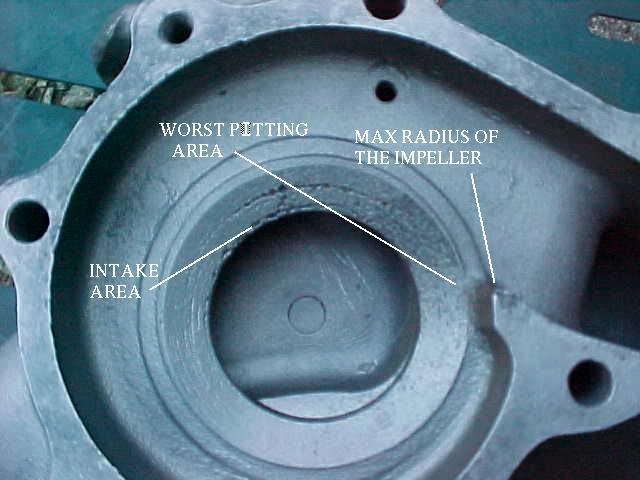
Read the text and look at the picture again.  That is on the INLET , not the
outlet or outer diameter of the pump impeller.

Tracy Crook
rws@altavista.net
www.rotaryaviation.com
I have read the text a couple of times.
I don't need the picture Tracy I have the pump right here before me.

The impeller is little larger than the chamfer you see. The max radius
of the impeller is limited by the wall indicated on the right.
Yes there is some pitting near the edge of the chamfer but most is over
by the wall. Also the impeller itself shows no sign of the "iron
worms" mentioned in his text.
We have very often talked with customers who tell us that their impellers are
"wearing out." Please understand that under proper operating circumstances
impellers simply do not wear out. If impellers in your centrifugal pumps
look like "iron worms" have been feasting on them in the
center of the impeller, you have suction side cavitation.
One the other hand he says:
If you have damage around the outer diameter of the pump impeller,
>>>>> AND IN THE CASING, <<<<<<<
you probably have discharge cavitation.
As I said over and over again inlet cavitation makes no sense in this case.
Fluid is incompressible and the system is pressurized. As much fluid comes
out of the pump as goes into the pump. The main restriction in the system
is right after the block (in the pump) and not between the rad
and the pump. If you add up all the areas of all the tubes in the rad it is
far more than twice the area of the restriction. Furthermore there is
a big hose between the bottom of the rad and the pump. That makes
inlet starvation less likely.

Perhaps there is both types of cavitation which I guess is possible in a
closed loop system like this one. Unlikely in an open loop system that
you are most familiar with.

Take the top off your pump and look inside. Stick your finger in there
and feel around. Don't get it stuck :-) The restriction is right under
the upper most bolt boss. It is hard to see without cutting off the pump
like I did. It is easier to feel if the pump is off the engine. Stick
your finger into the pump inlet port from the direction of the block.

I suspect the pressure build up on the back side of this orifice is a
nonlinear function of the fluid velocity. Maybe a square law function
of pump RPM.

Paul Lamar

The Aircraft Rotary Engine Newsletter.              Powered by Linux.

http://home.earthlink.net/~rotaryeng/            http://www.linux.org