Wschertz@aol.com wrote:
In a message dated 6/6/0 10:11:35, you wrote:
If you have damage around
the outer
 diameter of the pump impeller, and in the casing, you probably have
discharge
cavitation.
BINGO BINGO BINGO BINGO !!!!!!!!!!!!
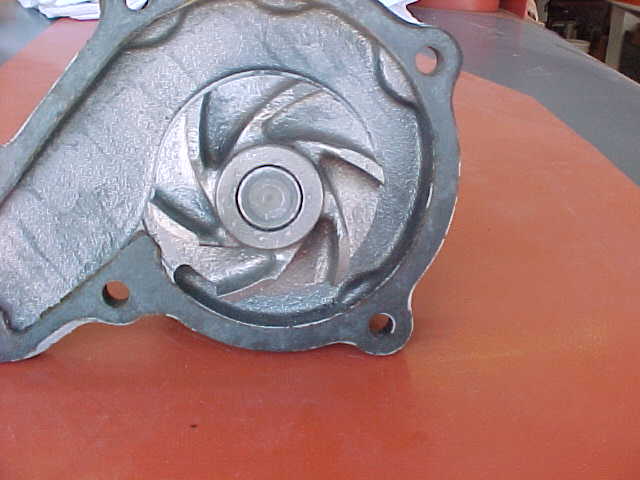
Here is a picture of my pump.

Note the pitting in the casing!!!!

I am already on the right road to fixing this.

Check your pump Tracy and everybody else.

Paul Lamar
----------------
Paul ,
when I look at the picture you sent, I see pitting on the CASING, but near
the INLET (I think) of the pump (indicating suction cavitation).

  From the description of the article, for discharge cavitation, I would
expect it near the outer rim of the casing, near the edge of the edge of the
impeller.

What does your impeller look like?
Bill
The impeller is in fine shape and you can see looking at this picture
of the impeller where the real input area  is.

Actually it does not matter what kind of cavitation it is in a closed
loop system. The overall restriction in the closed loop system determines
if the pump cavitates at a given RPM. Obviously less restriction, higher
cavitation RPM and higher flow.


Paul Lamar

The Aircraft Rotary Engine Newsletter.              Powered by Linux.

http://home.earthlink.net/~rotaryeng/            http://www.linux.org