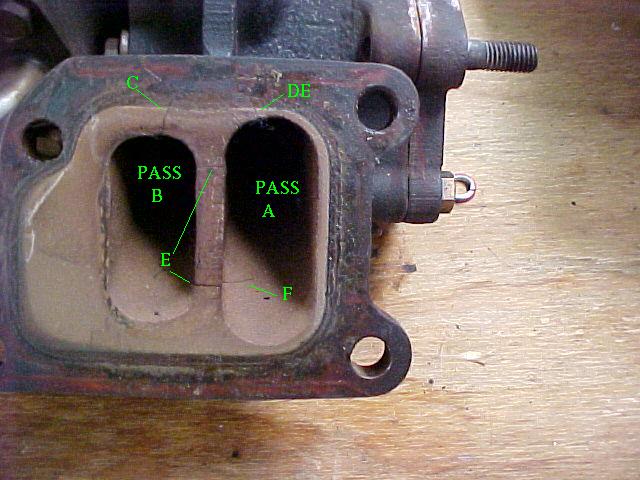
Took the turbo off and found some cracks. C, DE, E, and F. I took it down
and showed it to John at Mazdatrix. He gave me the history on the Turbo II turbo
problems. According to John the cracks will get worse and worse and
the manifold will crack eventually as well. It took Mazda three years
to solve the problems so if you have a 1990 through 1992 Turbo II engine
it might work better. This one is an 87. John also said the built in waste
gate was too small and the unit might over speed with an open exhaust at
high altitudes. The built in waste gate is indeed very small.

Here is how it works. At low to medium power, passage B is blocked
by a door located in the exhaust manifold. All exhaust goes through
passage A spinning the turbine up faster. At higher speed the door opens
and both passages get full exhaust. Unfortunately the divider then also
sees the full exhaust and reaches a higher temp then the rest of the housing
causing heat stress cracks. John says it is good for about 100K in a car
and then you need a new one ($1800 from Mazda) along with all new hoses and
connectors. In an airplane we will call on it a lot with both passages open.
In fact I had planned on fixing the door open at all times.

In 1990 Mazda redesigned it making it better but still probably not
good enough for use in an airplane.

He suggested a custom manifold and an Inconel TO4 for durability. A TO3 is
about the same size as this turbo but it too would be subject to
the higher heat stress.

Too bad. Real nice packaging on the part of Mazda.

BTW the turbo alone weighs 23 pounds. I don't have the exhaust manifold
off yet but I would guess it is around ten or twelve pounds.

Paul Lamar

The Aircraft Rotary Engine Newsletter.              Powered by Linux.

http://home.earthlink.net/~rotaryeng/            http://www.linux.org