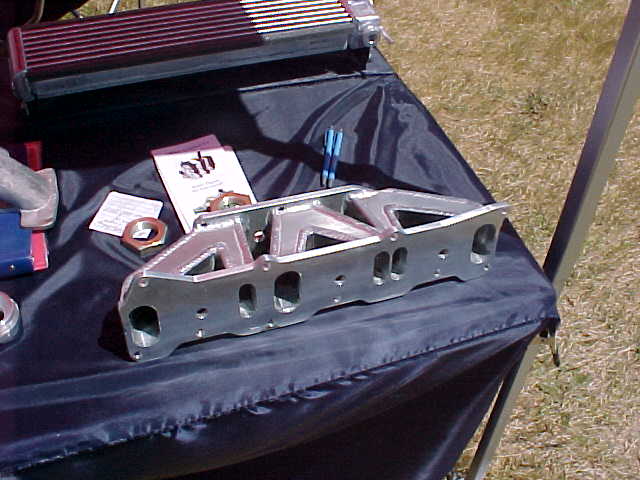
BTW what do you think of this manifold for a 20B?
Paul Lamar
Paul Yaw wrote:
I think it's crap.  I didn't respond originally because I thought Al built
it, and I didn't want to rag on him.  I emailed him and found out he didn't
make it.  I should have known.

I prefer long runners, but I know they don't always fit an airplane.  This
was designed to mate to a 3 barrel throttle body and because the spacing is
so different from the engine, the angles are absurd.  I would guess that the
flow is very different to the three rotors.  It's just nasty!  I don't know
what else to say.  This could have been done much better with mandrel bent
round tubing.

My approach is to build several pieces with adjustable lengths and test
them.  It's a pain, but it does guarantee success.  When you get around to
building your own manifold, don't use any of the stock pieces.  They all
suck.

Ask Mederer about some of these things.  He has probably tried more than
anyone.  I'm very impressed with his approach to engine building.  I have to
build a motor for my dad for a street car project.  I'm looking for a torque
peak around 5,500 to 6,000.  I'm going to use the TII side housings, and
I'll fabricate the manifold.  Adjustable lengths of course.  When I'm done
(I have to build a car first - A rotary bug.) I will give you the dyno
results from the manifold testing.

Thanks for answering my question.  It helps ALOT.

PY
charles.harbert wrote:
Paul (Yaw), could you be a little more specific as to what you didn't like about
the short 20B manifold ("crap" too generic). A friend of mine built it and I've
looked at it closely. The only way to meet the space available (5" wide) was to
construct it as a combination IR and small plenum inlet using 1/8" flat
aluminum.  It may look crude from the outside, but the inside is blended and
smoothed with no square corners. Actually, the outside isn't bad.

Are you objecting to the flow paths, or the quality of construction, or the
runner lengths, or .....? I agree that the air must make some abrupt direction
changes which are not good for high rpm efficiency, but the space constraints
caused this. Would the small plenums inside the manifold help overcome the
change in direction?

Finally, you said that you can build tuned length manifolds, but it is a trial
and error process which to me means it's pretty expensive. I was talking to Bob
Darrah and he's trying to keep the cost of the manifold under $500, whereas to
build a tuned manifold (incl testing) is probably well over $1,000. What would
be your estimation of the difference in hp between a short maifold and a tuned
manifold running between 4-6,000 rpm? Thx.

p.s. Really enjoyed your money tech articles.
The Aircraft Rotary Engine Newsletter.              Powered by Linux.

http://home.earthlink.net/~rotaryeng/            http://www.linux.org