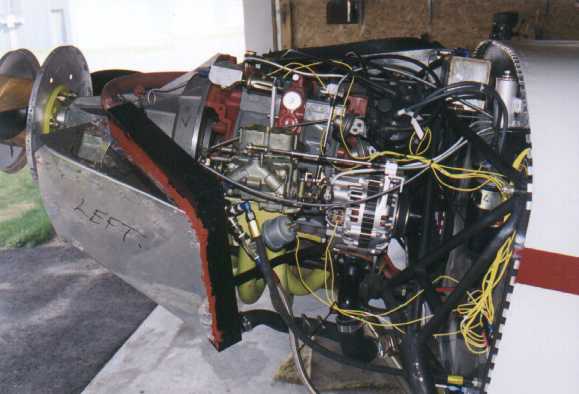
Here is an old message and picture on the subject from the CD.

Mon, 16 Aug 1999 17:30:06 -0700

Paul wrote:
This is the left side. All this goes to show you
that, what I call the "ramp diffuser" or "wedge diffuser"
works great. I have a few other examples which are not as pure
an experiment as Jim Mosur's setup shown here with the
possible exception of Ted Mayfield's Wankel GmbH
powered Hiperlite. Most so far use more than one rad.
IOW at least one rad was mounted in a conventional duct.
Chuck Harberts airplane is one of those.
Ted Mayfield uses one rad mounted horzontally under
his engine and a very crude and simple scoop with
no boundry layer bypass. I will show you a picture
of that next.

What we are looking at here IMHO is nothing less than
the future of cooling systems for liquid cooled
aircraft engines.

Kuchemann & Weber treated this mathematically
in their classic book, "Aerodynamics of Propulsion"
published in 1953 but they had little experimental
data to back up the theory. They called it "block in
oblique flow". I suspect one of the reasons it
works so well is the air is forced into turbulence
as it turns the corner to go through the core.
Turbulence is highly desireable for transferring heat.

Jims-left-side.jpg

The fact that the rads are made from brass helps but
not that much.

Paul Lamar
The Aircraft Rotary Engine Newsletter.              Powered by Linux.

http://home.earthlink.net/~rotaryeng/            http://www.linux.org