Paul wrote:
When I first read the book Compact Heat Exchangers by Kays and London
I missed this reference. My problem was the non standard nomenclature.
Kays & London refer to an inlet diffuser as a "header".
Here is a reference from the book that looks very interesting indeed.

"Oblique Flow Headers for Heat Exchangers". Trans. ASME, vol 90, p.271
1968 London, Klopfer & Wolf.

I will try to get down to the UCLA library next week and look this
paper up and make a copy.

Paul Lamar
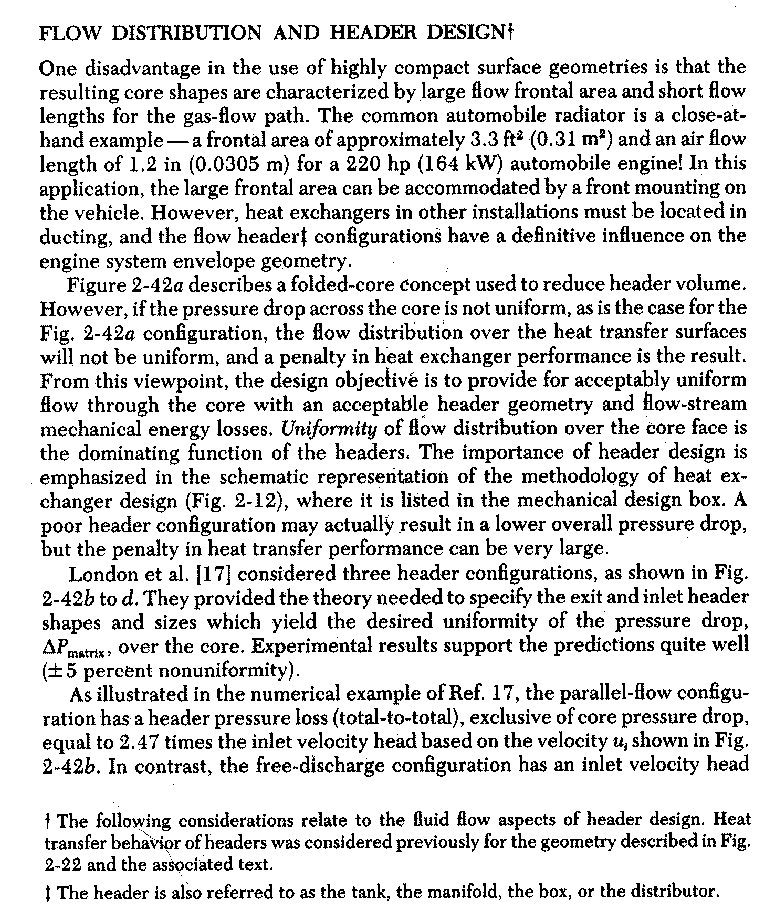
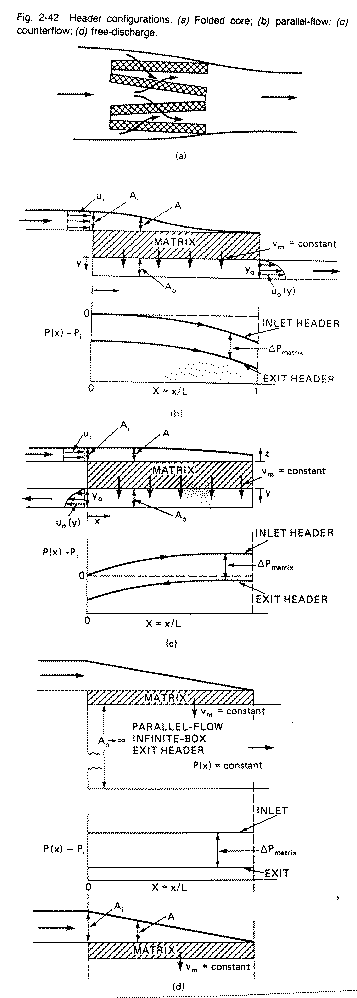
Ok here is some preliminary stuff on this paper I think. This is some of what
London published in the book "Compact Heat Exchangers". I will know more when I get
a copy of the original paper. What you are looking at here is the start of the theory
on all future water cooled aircraft engine cooling systems. These configurations
allow a designer to keep the aircraft frontal area and consequently the aerodynamic
drag down, the radiators located in the cowl and the cores thin for good airflow
at climb speeds.

London really threw me off when he called the inlet diffuser the "Header".
Obviously he was unaware of the work that Kuchemann & Weber outlined on oblique
cooling blocks in their book the "Aerodynamics of Propulsion" ten years prior.

BTW the shape of the inlet diffuser in diagram (b) is more or less what
I came up with using a furnace blower, a fabricated inlet test diffuser and
an airflow speed meter. This shape gives uniform airflow through the core
more or less. London alludes to the fact that it is not all that important
to have uniform air flow through the core. Certain airplanes are cooling well
with inlet diffusers that look like shape (d). Configuration (a) is also suggested
on the ACRE NL web site and is now universally used in almost all heating
and cooling systems.

Paul Lamar

The Aircraft Rotary Engine Newsletter.              Powered by Linux.

http://home.earthlink.net/~rotaryeng/            http://www.linux.org