Ok here is some preliminary stuff on this paper I think. This is some of
what
London published in the book "Compact Heat Exchangers". I will know more
when I get
a copy of the original paper. What you are looking at here is the start of
the theory
on all future water cooled aircraft engine cooling systems. These
configurations
allow a designer to keep the aircraft frontal area and consequently the
aerodynamic
drag down, the radiators located in the cowl and the cores thin for good
airflow
at climb speeds.
Al Gietzen wrote:
I'm sure this is dangerous because I don't have the data to back it up; but
from what I see on your attached diagrams; my opinion is that they are all
quite bad for our purposes where we have low pressure head to work with, and
I find nothing in the included text to indicate otherwise.  I wouldn't use
one of those header ("diffuser") configurations without testing it first.
They each have problems with either flow distribution or pressure drop (or
both).

I haven't looked at that reference for many years, but I think they were
looking at cases where a couple psia was considered a small drop, and I
recall at some point concluding that some of their test results were
questionable (even if we do share Alma Maters).  1 psi is a big drop in our
application.

Just a caution to look closely at the whole story on these, and probably
stick with Kucheman and Weber.  Oblique flow to the face of the rad is OK,
but lets do a proper diffuser.  And having the air come to a stop at the
exit (infinite box; or inside of cowling) is also a 'loss' and to be avioded
if you can.

Al
Well we have some examples Al that are working well. I have recently uploaded
pictures of Jim Mosur's and Jim Rahm's Lancair IV. Rahm's airplane came in
second in the race from NC to OSH at 330 MPH with a 450 HP V8. both use a
simple wedge shaped diffuser. I also have pictures of a Orenda 600 HP V8
powered duster with the rads placed under the engine in the horizontal
position with a rather small intake duct area.

Several people have ignored or not known about this info which has been available
on our web site, on this list and on the CD for at least a year and consequently had
cooling problems. The latest example is the Power Sport RV6.

I will have a lot more of this in the near future. IMHO it is by far more important
than the size and type of rad or the water pump flow.

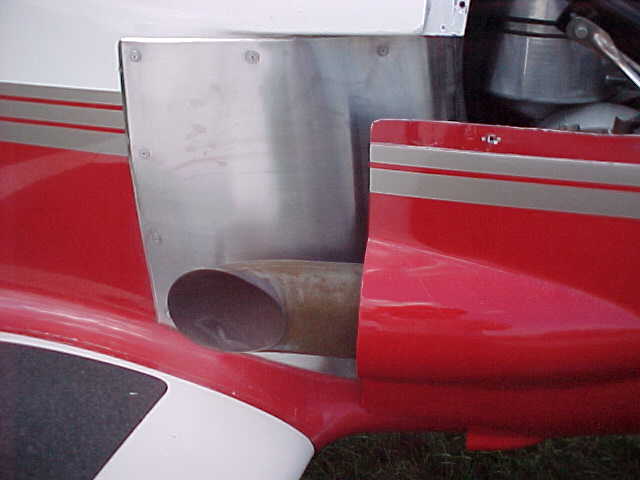
I don't think anybody is advocating having the air come to a stop inside of
the cowling. Most have some sort of exit area and the ideal would be cowl flaps
with a thrust augmentor. This is a nice exit seen on a Orenda powered
Lancair Tigress at OSH.

Paul Lamar

The Aircraft Rotary Engine Newsletter.              Powered by Linux.

http://home.earthlink.net/~rotaryeng/            http://www.linux.org