Jeff Spitzer wrote:
You bet!  The absolutely positively best way is to have a the pressure cap
on a tank that is not in the main flow path.  Rather the tank is part of a
parallel path.  What you want to do is install the tank in parallel with a
pressure drop, either the engine or the radiator.  Then you restrict the
flow in the tank circuit such that only a pee stream actually flows through
the tank when the system is flowing.  The goal is to have the coolant in
this tank spend a lot of time there.  Also you want the incoming flow to
enter below the water line so that no air is entrained.  The theory is that
the coolant has plenty of time essentially sitting still to get all the air
out.  As the engine heats up the air is expelled through the pressure cap.
You can even go one better with this system which is to only run this tank
half full and use it as the expansion volume.  You allow the cap to expel
overboard and suck air as required because you know it will always be air
and that the air will always be above the coolant and will not be
entrained.  The other part of the theory is that all of the coolant will
eventually make a pass through this tank so the average time to completely
de-aerate is about 1/2 hour of running after a total system drain and
refill.  If both lines that lead to and from the tank are small then you
need a fill cap (not pressure relief!) at the high point somewhere else.

Cars use a different and viable technique.  The theory is that you really
don't need 100% cooling capacity the first few times you start it.  (Do
you?)  Each time you shut down the car the coolant in the radiator sits
still long enough for the air to come out.  Next time you start, the air
that rose to the top of the end tanks is not re-entrained because the
coolant is moving slowly in the end tanks.  That is important...if the and
tanks aren't configured for low speed flow with the pressure cap at the top
this system wont work .  As the coolant heats up the air is expelled
through the cap and replaced on cool down with pure coolant from the catch
bottle.

What won't work:  If you have the cap in a high flow velocity area (like
paul's suggested pump mod) the air will take forever to get out.  Each time
you stop the air will be trapped in whatever local high spot exists in the
system (there's plenty of them)  When you re-start the air is immediately
re-entrained and zooms right past the pressure cap.  As the system heats up
a little bit of aerated coolant is expelled.  Yes, this is replaced by pure
coolant at shutdown but think how many heat cycles it takes to get pure
coolant (remember the example of trying to reach someplace by going half
way per step).  Go back to #1.  With that system you get PURE coolant in
about 1/2 hour.

Jeff Spitzer
What do you mean MY system???? It is exactly how Mazda does it. The filler
neck
just happens to be the highest place in the system. BUBBLES RISE! Just
like in
the car. Any car. Remember, the rad is under the engine. Where are you going
to
put YOUR tank? Try the top of the rudder :-) If you have room over the engine
such as in an RV4 or a pusher go for it. Most low cowls have no room above
the engine for such a tank.

Paul Lamar
Bubbles only rise in water that is sitting still or nearly sitting still.
The flow in our water pipes is 100% turbulent which means that any air that
that is present will be re-entrained.  Air can only be separated from slow
moving, non-turbulent water (or by inertia effects like swirl).  There is
no reason why the air separator needs to be at the top of the system.  The
only time the bubbles are heading for the top of the system is when it is
off.  Go back and read #1 again.  Put the separator tank anywhere you
want...high or low...it makes no difference.  Put the fill cap (without
pressure relief) at the top of the system.  This is too easy to make a big
deal about.  The above is based on countless hours of dyno testing on
various engines.  If you don't believe me add a sight glass to your system
and run it.  If the fluid in the sight glass looks the same sitting still
or moving (translucent, rich green/red color) then you don't have air.
Anyone who is not following one of the above described methods will have
milky whitish opaque fluid in the sight glass due to air entrainment.  This
stuff pumps and cools like crap!  Jon, you want to chime in here?

Jeff Spitzer
What you are saying Jeff is there have been about two  million rotary Mazda's made
with lots of air in the coolant and it was pumped and cooled like crap. I find that
a bit hard to swallow. No stock Mazda that I know about has a separator tank.
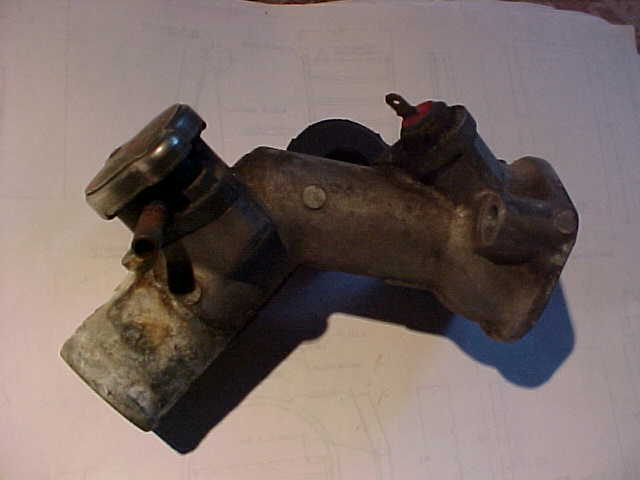
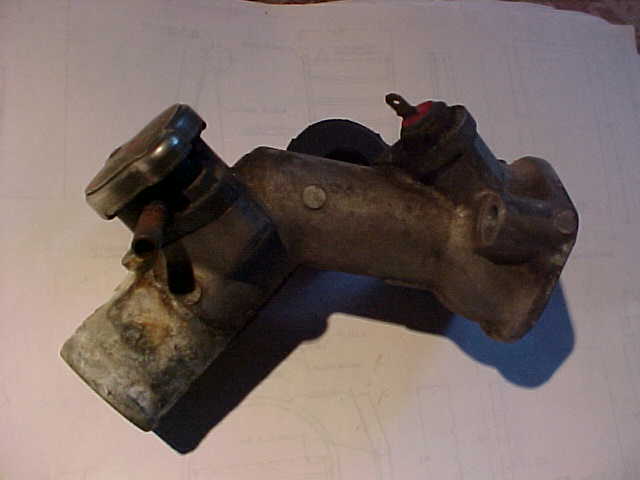
Here is a picture of a second gen RX7 13B pressure cap on the thermostat housing
and rad return pipe. Exactly like my modified pump except mine is about
four inches lower. I think you are forgetting the idle mode. When the engine idles
the flow is very low and the bubbles get a chance to rise to the high spot
and go out the pressure cap valve to the overflow tank.

Paul Lamar

The Aircraft Rotary Engine Newsletter.              Powered by Linux.

http://home.earthlink.net/~rotaryeng/            http://www.linux.org