Ken Powell wrote:
Paul,
You sent this graph out about 3 weeks ago.  The resolution is too low to > be
able to distiquish one line from another. Would you please
interprete it. It seems to indicate that port timing is only moderately >
important. Could you resend this with an arrow and a literal for each
line written on the picture itself? >
Thanks,
Ken p.
Just shows to go you the PP timing is not all that critical.
Only at the extremes does it matter much.
OK this is somewhat better resolution. BTW this data is largely obsolete
as I intend copying the Lemans engine for your peripheral port.
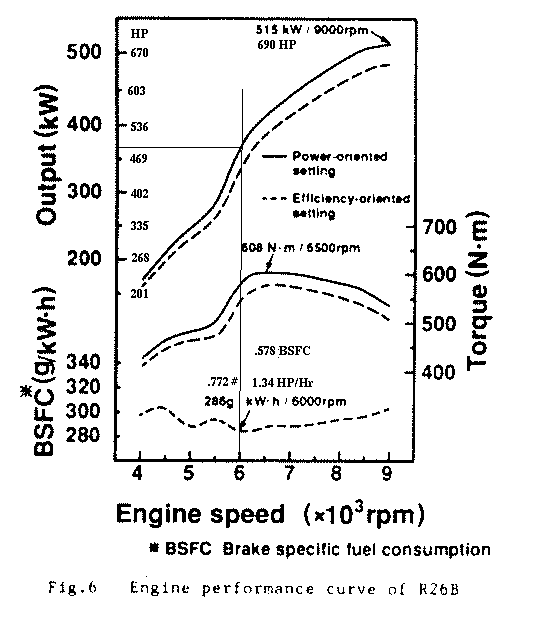
In theory it should be good for close to 240 HP at 6000 RPM.

Paul Lamar
Ken Powell wrote:
Paul,
Do you have the porting specs on the Lemans engine?  Here is Paul Yaw's
recommendation for an aircraft engine, which matches up with the graph you
resent this morning almost perfectly.  I would argue that when there is hardly
any difference in volumetric effciency that the more conservative of the porting
specs should be used (this should aid in getting the engine to idle since the
intake port will not be open as long to allow the mixture to be pushed back into
the intake at low revs):
A "race" peripheral port will probably make peak torque above 7000
rpm. If I had to build one for this application, my starting point
would be. IO = no earlier than 80 BTDC, IC = 50 to 60 ABDC  I would probably use
turbo rotor housings with stock port timing. EO = 73 BBDC EC = 48 ATDC  I would
probably have an inlet pipe diameter of 1.5"  That is where I would start, but
keep in mind that this is just an educated guess.  Some days  I guess pretty
well, and other days I think I am in the wrong business. > > >
Good luck

PY
Based on Paul Yaw's recommendation and the graph, I would use a IO=80 BTDC and a
IC=60 ABDC.

I have the rotor housings ready to ship.  I also have 2 throttle bodies of 2"
each and 2 throttle bodies of 1.57".  I am just trying to 'nail down' the final
porting specs and the size of the butterflies.

Ken Powell
Tuning for peak torque RPM has more to do with pipe length than timing.
Roughly speaking HP has more to do with port and runner size.
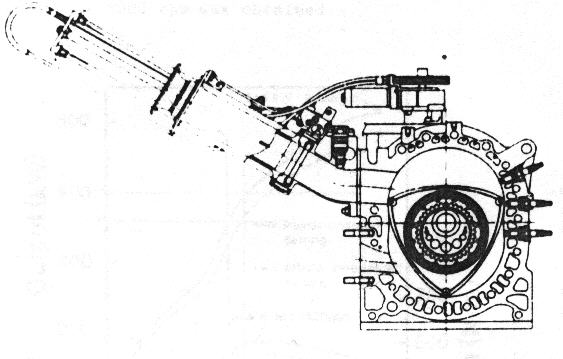
I would scale off this drawing as I don't have the timing specs for
the Leman engine. Jim Mederer is using basically the Lemans timing
and port sizes from the looks of his PP rotor housings.

Remember .746 KW equals one HP.
You divide these Leman engine HP numbers by two for a two rotor engine.
The pipe length in the Leman engine is fixed for best HP at 6000 RPM
for our use.

Paul Lamar

The Aircraft Rotary Engine Newsletter.              Powered by Linux.

http://home.earthlink.net/~rotaryeng/            http://www.linux.org