Another old message. This one dated May 2000
Al Gietzen wrote:
Unlike a P51 this scheme adds no frontal area to the airplane.

Just to clarify this statement the frontal area is technically defined
as the maximum cross sectional area of the airplane. If you park
the airplane in front of a wall facing away and shine a powerful
light from a long distance away it is the area of the shadow on the wall.
The drag is usually directly proportional to the frontal area
so if you add ten percent to the frontal area you will add ten
percent to the drag which is a lot!!! Not a good idea.
Your right; except a scoop is not 'frontal area' since the air (presumably)
goes in and not around.  The drag associated with the scoop is determined by
inlet and outlet efficiency and the drag caused by the radiator inside.
Most cowling inlets are effectively frontal area since they are usually not
well designed; air is brought essentially to a complete stop, and turned,
etc.  The P-51 scoop was well designed and had a drag much less than it's
frontal area.

Al Gietzen
Yes that is what was claimed but some experts disagree.
"drag much less than it's frontal area" times what Al? :-)
What was the C sub d for the P51 duct frontal area?

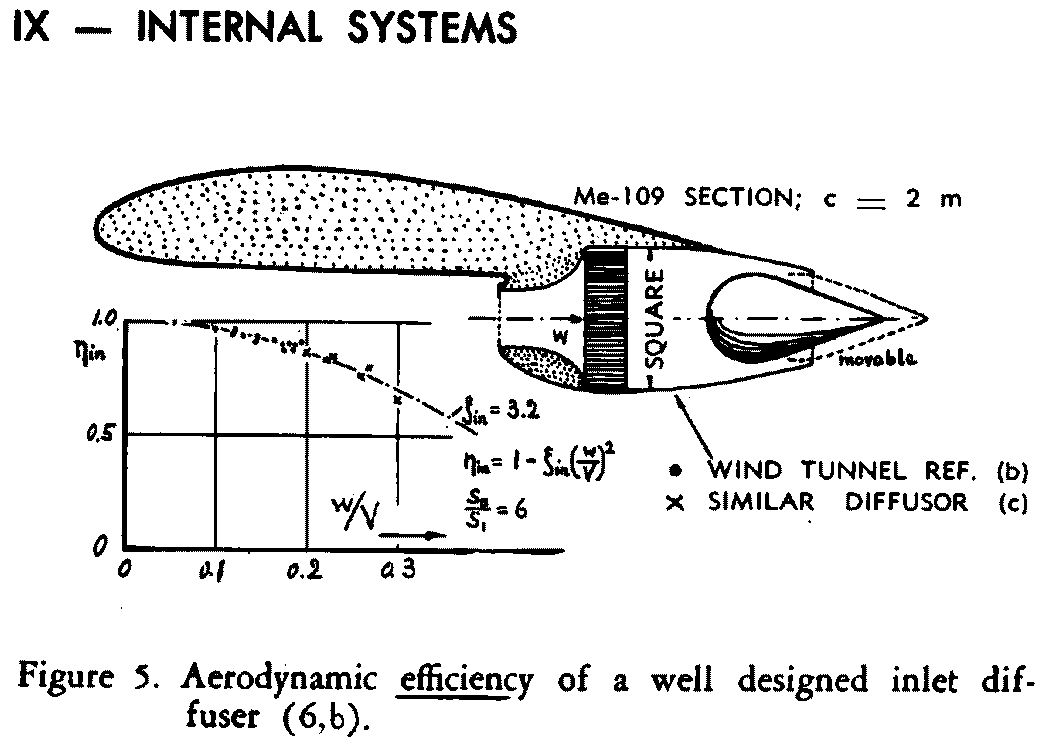
Of all the cooling drag data Hoerner has in his classic book, the bible of drag,
"Fluid Dynamic Drag" these are the lowest numbers as shown in the attached
scan.

Kuchemann and Weber in their classic book "Aerodynamics of Propulsion"
also agree. Note; the short length and the characteristic bell shape of
the duct. Tracy himself has recently confirmed these findings.

David Lednicer also agrees. It don't look like no P51 duct to me :-)

Furthermore modern wisdom on rads says that thin is better than thick
so an oblique thin radiator is better than a thick perpendicular rad
as shown here. Particularly at the speeds we are flying at. Kuchemann
and Weber mention this too although they have no data as the book was
published in 1953 before thin rads were common. IMHO Further improvements
can be had by designing the core for oblique mounting with staggered tubes.
All air-condition/furnaces now use oblique mounted heat exchangers.

In fact a certain person on here has recently given up on the P51 style
cooling duct. I will let him speak for himself if he wishes.

As I said before I think we can do much better than a P51 by eliminating
the frontal area of the external duct and using a thin rad.

We have discussed this on here before at great length.

Paul Lamar

The Aircraft Rotary Engine Newsletter.              Powered by Linux.

http://home.earthlink.net/~rotaryeng/            http://www.linux.org