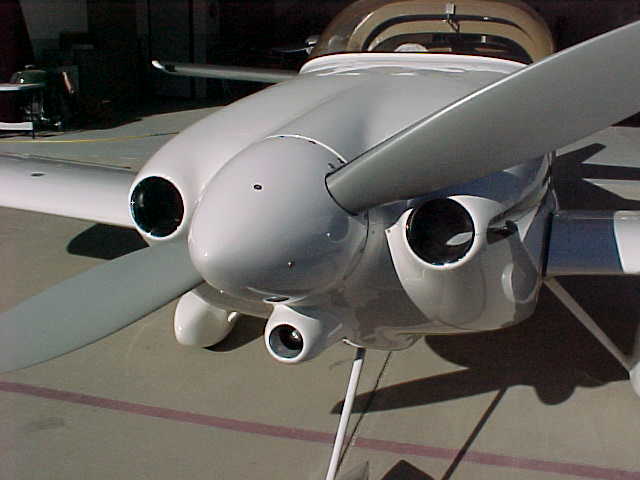
This is a picture of Steve Barnard's RV6A. This is the fastest RV6A
in the country and probably the world at about 235 MPH.
One of the reasons it is so fast is a lot of attention has been paid to
reducing cooling drag.

It is predicted by theory and proven over and over again by experiment
that a round hole near the front of the cowl is the most efficient way
of taking in air. NACA ducts work well further back on the cowl or
on the fuselage. Round holes are also efficient in pito tube type intakes
further back where the boundary layer thickness is a significant
problem. The P38 and Me109 had such intakes for carb air.

In an arm pit type situation under the wing the boundary layer
is likely to be less thick or the pressure in the boundary layer higher
than elsewhere on the airplane. In this case a NASA duct would work
well or a pito may show no advantage over a simple scoop.

Paul Lamar

The Aircraft Rotary Engine Newsletter.              Powered by Linux.

http://home.earthlink.net/~rotaryeng/            http://www.linux.org