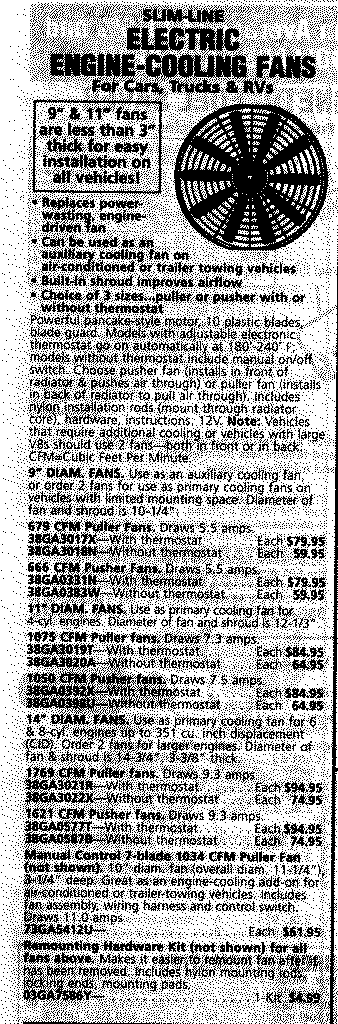
This is the only ad for electric fans that I can find
that specify the current drain. This came from JC Whitney
Cat #631T page 213

For a rotary powered helicopter this is probably the most practical way
to go.

Also if you have a marginal cooling system on your airplane for
climb this too might be an alternative to a larger
cooling system. You will have to stop the fan blades from spinning
when the power is off to the fan motor.

BTW The minimum cooling requirements for an airplane
happen during high speed cruise. The drag polar is near minimum
at cruise.  At climb the air speed is lower and HP is more.
At top speed HP requirements go up with the cube of speed while
air supply flow rate goes up with only the square of speed. The water flow
rate, assuming the pump is not cavitating, goes up directly with RPM so
the water flow rate may be limiting the cooling at top speed.
All this assumes that the water temp is more or less constant
(220F) which is typical for water cooled engines. Therefor the rate of
heat transfer due to the temp difference is more or less constant.

With an air cooled engine, on the other hand, cylinder head temp goes
up (500F) at climb and top speed so the delta T between the cylinder fins
and the ambient air temp also goes up as does the rate of heat transfer.

This is the cross we have to bear with water cooling.

All this is also why there is no unified theory of cooling :-)
Never the less it is good to know or find these relationships
(if I am wrong) so one knows how to solve cooling problems.

Paul Lamar

The Aircraft Rotary Engine Newsletter.              Powered by Linux.

http://home.earthlink.net/~rotaryeng/            http://www.linux.org