Peter Nun wrote:
Now you are talking paul, I have toyed with the idea of cnc machined
housings that replace the steel parts and using a ceramic compound such as
apticote ceramic 2000 on the housings to get a long lasting wear surface.
The only genuine parts would then be the shaft, rotor and possibly the
flywheel.  Decided it is too ambitious for my first attempt, and for a one
off as well the high development cost seems eccessive.
I am however working on a replacement rear-end for the engine that replaces
the pully driven accessories with ones that are gear driven.  The end-plate
will take standard lycomming style accessories.  This was the reason for my
questions for the the ignition timing.  The final system I have come up with
is as follows:

1. High capacity water pump in the top right (looks like the KSE HPD looks
best but am trying to get mechanical drawings from them).
2. Combined positive displacement fuel pump and power steering pump.  (The
power steering pump powers my retracts.)
3. 2x Accessory outlets for vacuum pump or cs govonor.
4. 2x B&C 8 amp alternators.  The highest reliability ignition I came up
with is using these two to independently power a pair of CDI's for
upper/lower plugs. My initial idea for a unison lasar style electronically
boosted/controlled system worked out to be too complex.  Much easier to buy
off the shelf components.
5. Alternator drive.  This is at right angles to the eccentric shaft and is
once again gear driven.
6. Timing discs in the center of the assembly that is used by the CDI's.
Using standard magnetic pick-ups.
7. Oil scavenge pump.  Using an after market gear pump for this (Razor
performance) which could also allow for dry-sumping the 13B for aerobatic
use.

I have a local CNC shop that is willing to make the end-plates and gears.
Quite a simple system with the stock end plate being replaced with a backing
plate that holds the planet gears (3) then an end plate that has the
lycomming style accessory holes machined.  The alternator drive is a worm
gear behind the main spur gear, and the timing disks are then outside of
that.
All in all it should be quite a professional system with no belts or heavy
stock accessories.
The key however is the ability to kill the master switches (paranoid about
electrical fires in the cockpit) and still have the engine running off the
two small alternators driving the CDI's.  Also the reason for the mechanical
fuel pump feeding the injection system which will be an airflow perfomance
mechanical system.  I know you said that a computer controlled electronic
system provides better performance but I have three problems with it:
1. the abitity to run from 0 electrical power.
2. System redundancy.
3. I will not run a high pressure fuel return line back through the
passenger compartment.  I think that is a disaster waiting to happen.
If you want to follow this and use it when completed let me know.  I don't
plan to be fitting the engine till the end of the year at the earliest and
will be using the RWS redrive on the business end of the engine.
regards Peter
Sounds like the Mecanair Mazda from Switzerland Peter.
Their certainly will be a market for that kind of engine if
the Power Sport program is successful as I am sure it will be.
Ray is a dedicated person to the rotary aircraft engine cause.

For the scaled down ultra light version of the Mazda;
Since we don't need the oil injection pump, exhaust gas re- circulation,
distributor (crank trigger) or the oil pump chain drive the engine would
be even simpler than the Mazda. Here is what I suggest for an oil pump.
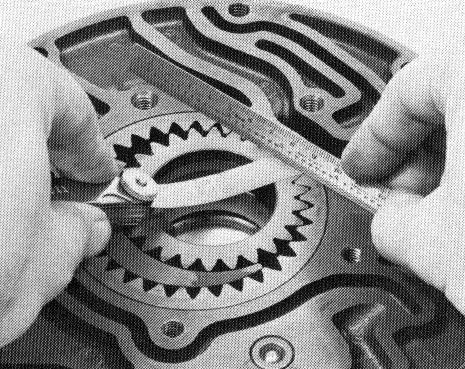
It is an oil pump from an automatic transmission and all late model GM
LS series V8s are now using this type of oil pump directly driven by
the crankshaft or e-shaft in our case.

The steel rotors could be made on an NC mill in two
light weight halves. Then dowel pinned for alignment and furnace braised
or TIG welded together. I would NOT machine the gear into the rotor like
Wankel did it. I would copy Mazda and use roll pins. I think that was
part of Wankel GmbH's problems when it came to running the engine at higher
than 6000 RPM as their rotor gear was integral with the steel rotor. We would
then reap the benefits of much higher RPM such as the new side port engine
from Mazda without the high tech casting techniques. I would also
use simple one piece apex seals as the two & three piece were developed
mainly for smog and low power BSFC.

Paul Lamar

The Aircraft Rotary Engine Newsletter.              Powered by Linux.

http://home.earthlink.net/~rotaryeng/            http://www.linux.org