<<  Since the rotary is capable of running very lean it is apparently
 > > very important to have a good ignition system.
 > > Here is a chart from Klause Savior's LSE forum at the Golden State
 > > flyin.
The Chrysler lean burn ignition from the 70s was just a MSD in a
Chrysler
box. I use two MSD 6ALs with built in rev limiter. With the plugs gapped
at
.012" we have no problems, too rich or too lean makes no difference.
Don't
let one of these bite you. It will lay you out in the grass for a while.
You
can weld the latch shut on your metal watch band.
Lynn E Hanover
BTW Klause also mentioned that a longer gap has a higher probability
of finding a fuel molecule to ignite. He recommended a .016 gap
for an aircraft piston engine.

Paul Lamar
Tracy Crook wrote:
I'm confused.  In my experience, even .016 is an anemic gap.  Check out the
gap on a stock Mazda rotary plug (not adjustable).  It's something like
.040" - .050".

BTW, The coil energy on the stock Mazda coils is very good, and being an
inductive system, the spark duration is very long which is what you want
under lean conditions.  CD systems have a very short duration.  MSD
(multiple spark discharge) has to make many sparks to make up for this
shortcoming.  It also eats a ton of electrical power which may be of
interest to those concerned about battery life in the event of alternator
failure.

Tracy Crook
rws@altavista.net
www.rotaryaviation.com
I thought the rise time of the CD was important for punching
through plug contamination. At least that is what they told us.
Interesting on the gap. I never even looked at the stock gap or if
I did I forgot what it was. I just put them in there :-)

I agree on the current drain at high RPM. Induction systems
at low RPM draw a lot of current. The induction coil is allowed
to saturate with current and then the breaker points or transistor
interrupt the current flow every once in awhile to cause the high
voltage spark. At low RPM the coil just sits there most of the time
just waiting and  drawing a lot of current.

A CD on the other hand rapidly charges a capacitor to a high voltage
(on the order of 300 volts) and the current flow stops
more or less except for small bias currents in several transistors.
When the time comes to fire the plug a transistor turns on and
dumps the voltage charge rapidly through the primary of the coil causing
the high voltage spark. This is why you get a fast rising pulse
of high voltage. Must be something to do with it as CD's are widely
used in racing for the past 30 years or so. I built my first CD
system back in the early 60's using vacuum tubes.

The issue here as far as current drain has to do with the efficiency
of the circuit that generates the 300 volts to begin with all other
things, like spark energy, being equal. I really doubt there is much
of a difference in over all current drain.
I would like to see some numbers.

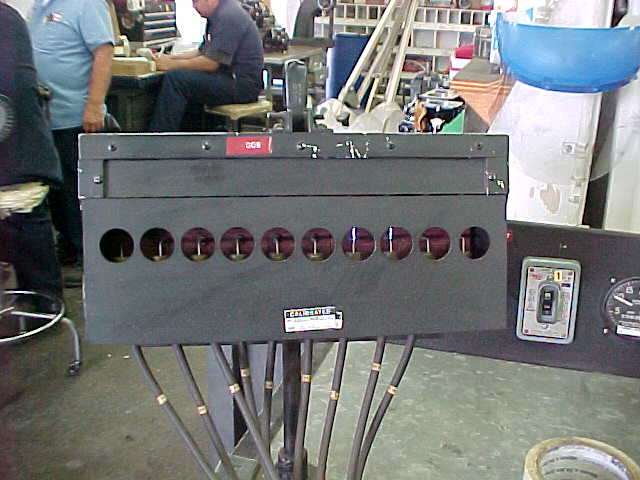
BTW this is a magneto testing machine testing a R985 magneto.
As you can see the firing gap is rather large at sea level pressure.
Since air is an insulator the higher the pressure the better
the insulation and that is why the gap is less in a spark plug
because of the compression ratio.

Paul Lamar

The AirCraft Rotary Engine NewsLetter.              Powered by Linux.

http://home.earthlink.net/~rotaryeng/            http://www.linux.org