To All Hmmmmmm....ers:

Re: Waterpump capacities

The reason I picked 37 gpm in my previous post is because that is what
Powersport had discovered in their tests.  37gpm will support 120 HP at 20
deg F temperature rise with 50:50 water/glycol mix.  (Specific heat of glycol
is .3!)  I selected 215 HP as that is the HP that Powersport can generate at
WOT, corrected to sea level..I presume.  That also seemed like a rational
upper limit for a 13B N.A.  If a waterpump can cool 215 HP at sea level, it
can cool any other amount of HP that powerplant might put out, as we know the
output drops off approximately 3.3%/1,000 ft and the temperature of the air
drops 2 deg C (3.8 deg F) per 1,000 feet (approx. 0.7%-Rankine/Kelvin and all
that technical stuff) as a standard lapse rate.  Yes, the air density will
decrease approximately 1%/1,000 ft. as well.  My barometer is that cooling a
N.A. A/C engine at any altitude above 7,500 has never been a problem in 40
years.

Several responses re: the "hotter" exhaust convinced me that the temperatures
in the chamber are (cannot be) hotter, but there is a lot more of it and no
valves nor water cooled chamber between the chamber and the exhaust pipe.
Therefore the temperature which the exhaust must be able to contend with is
higher than a similar SI-C/S/P engine.

Oil Cooling
The specific heat of machine oil is 0.4 (that h20 stuff really is pretty good
at 1.0!!), and its specific gravity is .92.  (You can find this in
Machinery's Handbook-26th Edition on p365.)  If we assume from the charts
which have been provided online here, that 8% (.08) of the input fuel energy
goes into the oil....let's find out how much oil we have to circulate in
order to absorb and transfer this amount of heat:

    (215 HP) x (.6 lbs. fuel/HP/hr.) / (6 lbs./gal) = 21.5 gals/hr.
    (21.5 gals/hr.) x (100,000 BTU/hr.) = 2,150,000 BTU/hr.

    (2,150,000 BTU/hr) x (.08 rejected to oil) = 172,000 BTU/hr.**

    1 BTU/hr. = (1 lbs) x (1 deg F) / (0.4 S.H.) (.92 S.G.) = (2.72 lbs. oil)
deg F / hr.
    172,000 BTU/hr. = (467,840 lbs oil x 1degF) / hr.

    Let's assume a desired 20 deg F temperature pickup in the engine.....

    (467,840 lbs x degF) / 20 degF = 23,392 lbs. oil / hr.
    (23,292 lbs/ hr) / 7.67 lbs / gal. = 3,050 gal/hr.
*****3,050 gal/hr. / 60min/hr. = 50.83 gpm!!*****
Note:  If we are willing to accept a greater temperature differential while
at max. possible power output which we will only use for limited periods of
time...say 40 degF (220-180degF), then the required oil pump flowrate is only
25.4 gpm.

Remember:  All of this assumes that the oil:air or oil:water cooler is able
to dispatch of these 172,000 BTU/hr.  But,....in order for the engine to
dispose of 8% of 215 HP to the oil with a temperature rise of 20 degF, it
must flow 50.8 gpm...or 25.4 if we are willing to accept a 40 degF
temperature rise.

Since 60% power at altitude is one condition at which we might cruise for
extended periods and at which we might lean significantly in order to reduce
BSFC, it is easy to calculate what gpm is required to keep the oil under
control at this power output (ignoring BSFC improvements):

    (129/215) x (50.8 gpm) = ~30.5 gpm for 20 degF, and
    (129/215) x (25.4 gpm) = ~15.2 gpm for 40 degF.

So, my Rotary will have an oil pump sized to provide 30 gpm through the
engine lubricating system at 5,200 or so rpm (cruise) and I will accept a
temperature differential of approximately 35 (215-180) degF during WOT 215 HP
TO/Climb.  If I cannot, then I must accept the fact that my oil pan
temperature will be commensurately higher.  Perhaps 250 degF oil in-pan
temperature is OK??  Certainly does NOT seem likely with water boiling at 239
degF, even at 10 psig.  Note: If anyone thinks they can control nucleate
boiling in their airplane, please do not fly over my house.  You may
unintentionally have it, but forget the control, and going off the backside
on the temperature/transfer curve is disaster!

Water Radiator Sizing:
It may be instructive to compare what would be required if one took a
successful air cooled (at least FAA approved!) system and worked backwards to
suggest the proper radiator and air inlet sizing for a Rotary.  Since I have
an IO-360/200HP Lycoming close at hand for measurements, we will use that.
Please note:  It came equipped with the largest inlet ingestion area one can
imagine.  It has had a cowl closure added (worth 5 knots!! and cools better)
and it is still larger than its outlet flaps could ever pass....so we will
use the exit areas as a way to work backwards into a possible solution.

 A.   Heat transfer metal-air (400-100 degF) = 300 degF differential
      Heat transfer water-air (200-100 degF) = 100 degF differential

  However, in order to ratio the methods, we must use the absolute zero
base ie...temperatures expressed in Rankine....degF + 460.  300 + 460 = 760
degR, 100+ 460 = 560 degR.
  ** 760/560 = 1.36** due to temperature differential of the medium.

 B.   BSFC = 0.6 Rotary, 0.45 SI C/S/P

  **.60/.45 = 1.33**  More energy into cooling system due to less
efficient conversion of fuel availability.
I think this is a mistake Doug. If you are comparing BSFC here the
rotary BSFC is .65 worst case at full power but at least 0.5 at cruise power.
Tracy claims about 0.47. The recip is 0.6 at full power and perhaps 0.45 at
cruise power. Is this what you are doing here? I am not sure. Paul Lamar
 C.  Assume that each engine rejects approx. the same % of fuel available
into the coolant system (a good assumption).

  D.  Mooney M20F
            Inlet area: 95 sq. in.  (still too large)
            Outlet flaps open: 68 sq. in.
            Outlet flaps closed:  31 sq. in.
            Oil Cooler:  (5.75 x 4.25) = 24.4 sq. in.  (approx. 3.5 thick)
                (surface mounted 8-10 in below prop spinner)

    ***Using the above ratios:

        (68 sq. in.) x (1.36) x (1.33) = 123 sq. in. (required area for
adequate lbm of air to exit with reject heat)

    Assume Mooney had it perfectly balanced(?!) between air and oil cooling:
2/3 air, 1/3 oil!!  Therefore: (123 sq. in.) x (.67) = 82.4 sq. in. for
cylinder cooling, ie..non-oil cooling and (123) x (.33) = 40.6 sq. in for
oil.

        Stewart Engineering says the maximum functional air grill is 1/3 the
overall area of the radiator or ...the radiator should be 3x the opening.
Therefore: one could be led to believe that, on a reject heat to air relative
basis, one should size the water radiator to be at least (82.4 sq. in.) x 3 =
247 sq. in. in radiator frontal area to cool 200 HP in climb/max cooling
rigging ie..flaps open.  In cruise, (31) x (1.36) x (1.33) = 56 sq. in., and
(56) x (.67) = 37.6 sq. in......(37.6) x 3 = 112.8 sq. in. radiator area.

BTW: 82.4 sq. in. = 2-41.2 sq. in. air inlets......2-5" x 8" (approx. 1/2 a
sheet of paper) or 2-7 1/4" dia air inlets.  Or if you like, measure the
openings that Loepresti has just designed for the Mooney 201 and multiply the
area by 1.33 (BSFC)! to get required air inlet sizing.  Haven't done that,
but I would judge we are pretty close.  If radiator mfgrs. would publish
BTU/min heat transfer at specified air flow, water and atomspheric
conditions, we could also be there quite accurately.....so far, I haven't
found any of this information.

Bottom line....shot in the dark....SWAG, but Mooney 200 HP Lyc. data
available: one would size the radiator for 248 sq. in. x 2 in. thick
(standard thickness).  Stewart also says doubling the radiator thickness
above 2 inches only increases heat transfer ability by approximately 25% or
the cube root of the increase.  So, 3" = 114% of 2", 4" = 125% of  2"....for
example:

    2-10 x 12.5 x 3.5 radiators = (2) (10) (12.5) (cube root 3.5/2.0) =
            (240) (1.21) = 290 sq. in. equivalent,

    1-15 x 18 x 5 radiator = (15) (18) (cube root 5.0/2.0) =
            (270) (1.36) = 367 sq. in. equivalent ,

    1- 15 x 32 x 1 radiator = (15) (32) (cube root of 1.0/2.0) =
            (480) (.79) =  379 sq. in equivalent!!

Before we leave:  Oil cooler....24.4 sq. in. x (1.33 BSFC diff) = 32.5 sq.
in. ( x 3.5).  If cooler is submerged, the opening could be 32.5/3 = 10.8 sq.
in. or a 3.5" dia. circle air inlet.

What works???

Venable??(notes don't identify who):  2-12 x 12 x 2 = 288 sq. in equivalent.
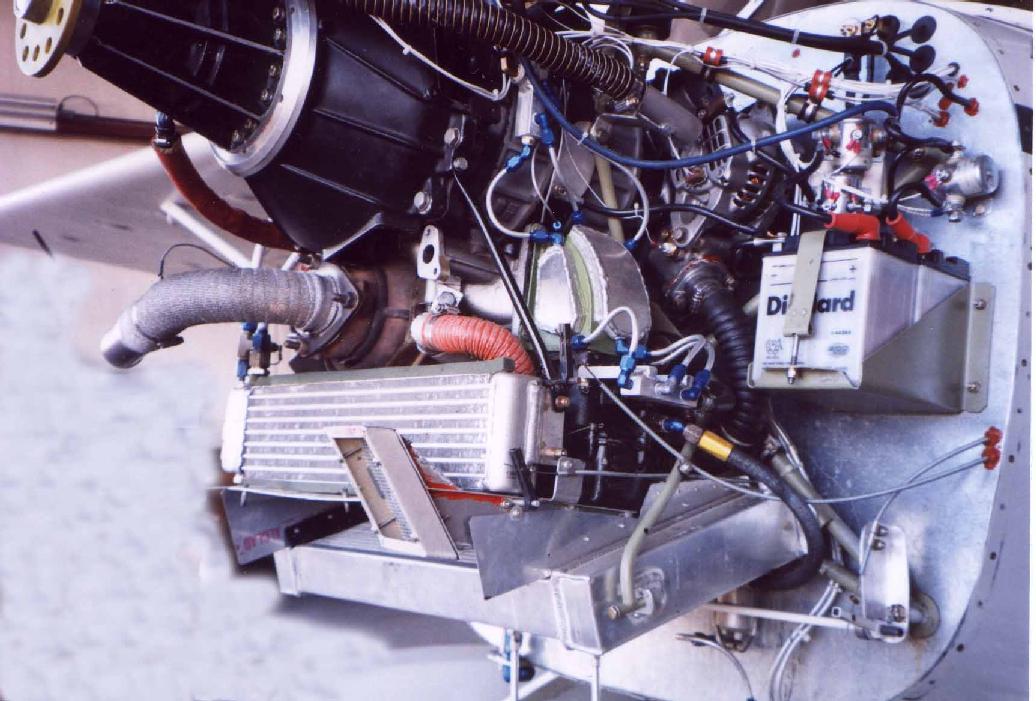
Not Andy Venable as he had a single large rad horizontally mounted
under the engine with a simple wedge shaped duct. Picture below.
Graham:  2-8 x 11 x 1.5 + 1-6 x 9 x 3.75 = 226 sq. in. equivalent
Anderson:  2-9 x 14 x 3.5 = 304 sq. in. equivalent
Crook: 1-9.5 x 11 x 3.75 + 1-9 x 13.5 x 3.75 = 286 sq. in. equivalent

YES....any and all of these can be effected by the airfoil of the
inlets...and they are very important and they may vary the ultimate results
from awful to great.  Awful may only cool 170HP at full tilt and GREAT will
run against the thermostat all the time once it is up to temperature.  What
is not to like?

>From my perspective, I think we are closing in on the size required and the
various ways one might use to get the workable combination for ones own
setup.  It certainly is a better method than selecting a radiator "because it
came off a German automobile".

Want to cool a 20B of 270 HP??

    (270/215) x 248 sq. in. = 320 sq. in. equivalent area...(107 sq. in. air
inlet)....water radiator,
    (270/215) x 32.5 sq. in. = 42 sq. in. oil cooler flush mount or submerged
w/ 11 sq. in. (4 1/4" dia.) air inlet for oil cooler.

In all of this I did NOT assume the exits were oversized relative to the
inlet area....as the Mooney obviously has far less outlet than inlet???  Why,
I have no idea.  I do know that what lbm. of air does cool goes out those
outlets?  I am also confident from the cowling closure work that lots of air
spills out all over the front of the plane and provides significant drag as
evidenced by the 5 knots of airspeed increase from reducing the air cooling
inlets!!  I can say that sometimes there "is free lunch"...and drag reduction
comes as close as any!  Lopresti agrees and has made his living at it!

FWIW:
For what it is worth....10 psi will flow 39.8 gpm of water through a 5/8"
hole!!  Let me see, 250HP for 6 seconds, nothing for 3 seconds (or are both
feet flat on the floor?), 160 HP for 5 seconds and then 250 HP for 6
seconds...........with real rich mixtures to help cool, 24 psi coolant
system.......does the 5/8"opening washer keep the waterpump from cavitating
at 9,500 rpm....Lynn Hanover???

Stewart Engineering NASCAR waterpumps flow over 175 gpm at 7,500 rpm, 20 psi
pressure drop, 20 psig system pressure, 200 degF!!  (800 HP @ BSFC=.6 with 30
degF temperature rise = 185 gpm requirement!!)

Stoichemetric fuel:air is maximum temperature and very, very close to maximum
power.  The good news is that: BSFC improves and the flame temperature
declines for quite a good % leaning beyond stoichemetric, without the HP
falling off appreciably.  On the rich side the temperatures are indeed lower,
the horsepower lower and the BSFC stinks, but improves rapidly as it
approaches stoichemetric fuel:air ratio.  There is lots more room on the lean
side than on the rich side for excellent power, acceptable temperatures and
good BSFC combinations, expecially for an engine that can stand the heat!!

Regards and POR,

Doug Dempsey
Good work Doug. As usual.

Paul Lamar

The AirCraft Rotary Engine NewsLetter.              Powered by Linux.

http://home.earthlink.net/~rotaryeng/            http://www.linux.org