> Mike, it's a combination of reasons, but it is a trade off. Water is about
the
 > best coolant there is, but it boils at a low temp (212F). You can put a
pressure
 > cap on the radiator to increase the boiling point, but if you add glycol
you can
 > really increase the boiling point. In essence, you gain more by increasing
the
 > boiling point, than what you give up in heat transfer loss.
 >
 > Chuck Harbert >>

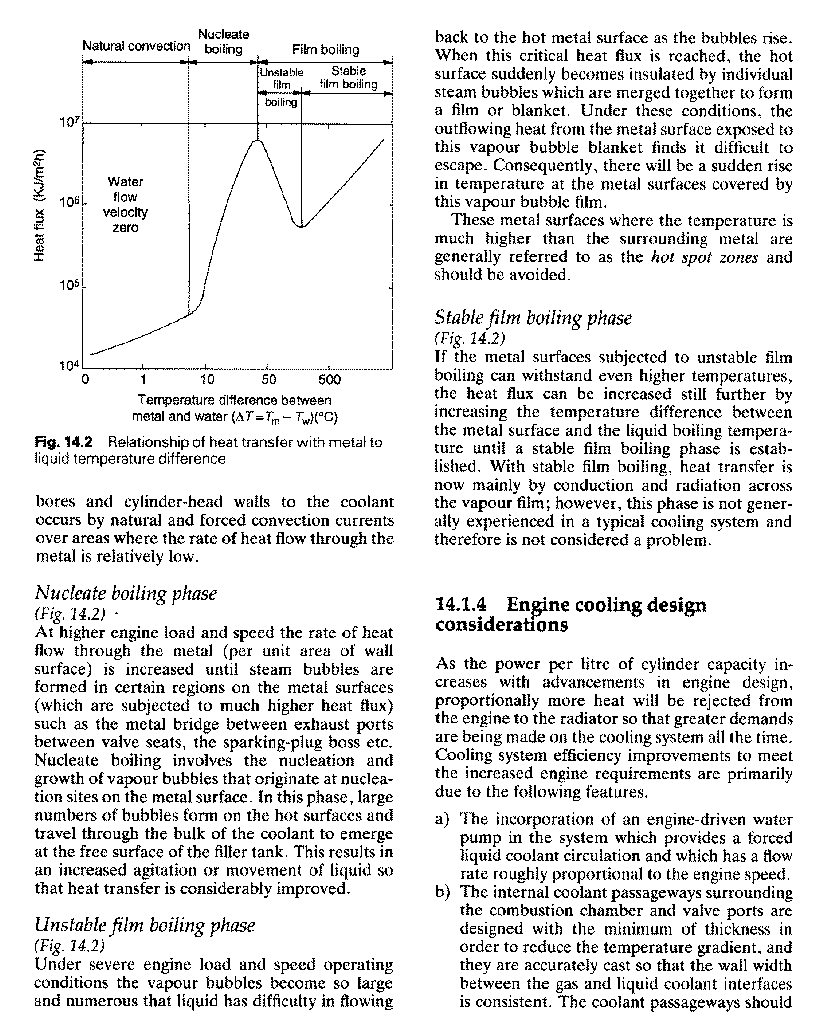
Raising the boiling point prevents boiling but *reduces* cooling
effectiveness due to the loss of nucleate boiling.  Also, as mentioned
previously, the glycol reduces the heat transfer of the fluid.  This means
that the housing/wall will run hotter with a glycol mixture than pure water
for the same coolant temp.  That's the main reason racers run pure water.
When you're pumping the max possible power out of a given engine displacement
you need the most effective heat transfer possible at the source...pure water.

Jeff Spitzer
This is well illustrated in this chart. On the vertical axis on the left labeled
Heat Flux each exponent increment represents ten times as much heat transferred.
In other words 10^6 is ten times as much as 10^5. There is no way in hell
a high power rotary will cool without nucleate boiling. Make sure you drill
a small hole next to the leading spark plug, down until you get steel
particles on the drill, about 1.40 inches deep and install a thermal
couple  at the bottom of the hole. As Jeff implied the housing/wall temp
is the bottom line. Pardon the pun.

Paul Lamar


The AirCraft Rotary Engine NewsLetter.              Powered by Linux.

http://home.earthlink.net/~rotaryeng/            http://www.linux.org