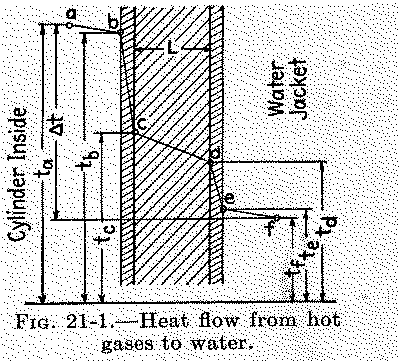
Here is some elementary theory on this subject from an engine text book.

Quote:
Of the three means of heat transfer,
conduction, convection, and radiation, in cooling engine cylinders,
conduction plays an important part in carrying the heat through the
thin layers of stagnant gas and water in contact with the walls. The
rest of the heat exchange is done partly by radiation but chiefly
by convection. The heat flow' from one fluid to another, separated
by a metal wall, can be best explained using the diagram in Fig.
21-1. The temperature ta of the gas at point a in the interior of
the cylinder gradually falls to the value tb at the surface of the
inert gas film. The resistance of this film is very great, a great
temperature head, tb - tc, being required to pass through it by
conduction. The temperature head required to cause the flow through
the metal wall is tC - td.  The temperature head required to pass
through the outside film is td - te.  Its value is comparatively
small if the cooling fluid is water and large if it is air.
Finally, the temperature drops to tf of the cooling liquid at some
distance away from the wall.

Using the over-all heat-transfer Coefficient U, instead of hm, the
general  equation per hour becomes;

Q = UA(t1 - t2)

and U can be presented as;

U = 1/(1/h1 + L/k + 1/h2)

where h1 is the inside surface coefficient, Btu/sq ft-degF-hr,
h2 is the outside surface coefficient, Btu/sq ft-degF-hr,
L is the thickness of cylinder wall, inches.
k is    the thermal conductivity of the metal, Btu/sq ft-degF-hr
per inch thickness.

End of quote.


The AirCraft Rotary Engine NewsLetter.              Powered by Linux.

http://home.earthlink.net/~rotaryeng/            http://www.linux.org