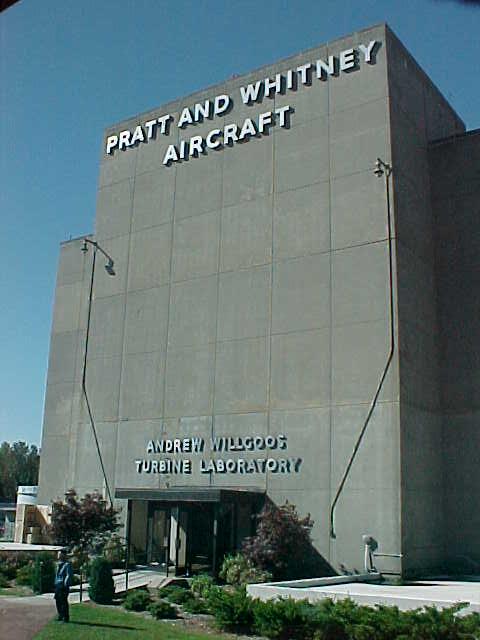
Testing turbo fans at altitude and speed.

It is easy to restrict the air going
into the engine to simulate high altitude but the problem is; what do
you do with the exhaust? You must suck it away faster than engine
under test can generate it. This is a tall order. It takes
a power plant the size of an average municipal electric generating plant.

Back in 1947 or so P&W bought a surplus W.W.II Destroyer Escort ship and
sailed it up the river to the plant site. They then stripped out
the steam turbine driven power plant with six huge boilers and connected
them to seven steam turbines and compressors used as vacuum pumps. This gave them
roughly 40,000 HP.  That was adequate to test the 6000 pound thrust turbo
jet engines of those days. As the engines got bigger and  bigger (now up
to about 100,000 pounds of thrust) they had to add vacuum  pumps and
more HP.

Finally they started to use three 50,000 HP FT4 turbo jet
engines sans tail pipes driving gas turbines that powered the vacuum pumps.
They liked the older turbo jets because the nox is only around 200 parts
per million due to the modest compression ratio.

The EPA specs on NOX emissions however is 75 parts per million so they
have to run the  turbo jets on natural gas to meet the EPA NOX specs.
Since the local natural gas supply pressure is not high enough to get the
required amount of NG into the turbo jets they had to add 800 HP diesel driven
compressors to raise the injection pressure since the fuel pumps on the turbo
jet engines are only 30 HP.

P&W have been building and adding to the Andrew Willgoos high altitude
(up to 65,000 feet and Mach 3) test facility for 50 years and they are
now  up to around 300,000 total HP roughly. Inlet temps can be provided
from 1000 F to minus 60 F. Air supply can be as high as 1,200 pounds
per second.

This is a fantastic facility on  58 acre with 350,000 square feet of
floor space and 15 test cells. If you ever get the opportunity to
take the tour of the P&W high altitude turbine laboratary in Hartford
Conn. don't miss it.

Paul Lamar

The AirCraft Rotary Engine NewsLetter.              Powered by Linux.

http://home.earthlink.net/~rotaryeng/            http://www.linux.org