Peter Johnson wrote:

Hello Paul, and everyone else, thanks for the great email list!

I am looking at putting a 13B NA into Anton Cvjetkovic's 'CA-65', a reat
combination I think.

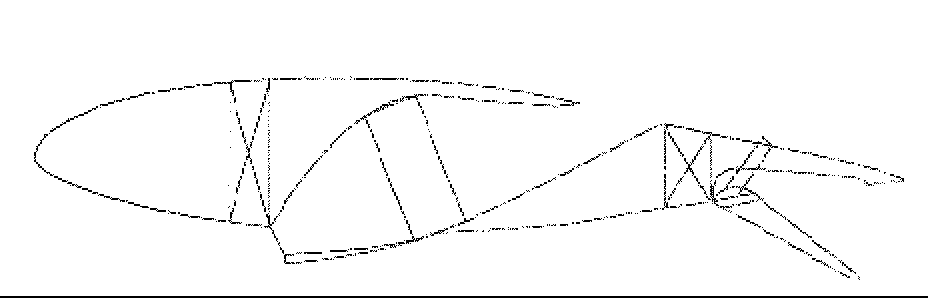
I have attached an idea for installing the common airconditioner exchanger in the
wings.
The duct would be located within the area of the prop wash and still provide room
for wing tanks.  Cooling lines would be located below the main structural cross
members and above the bottom ply, I intend to install the bottom ply with a camber
in it so there will be room for the lines.

Any comments and ideas from the list would be greatly appreciated, thanks!

mailto:pjohnson@voyageur.ca
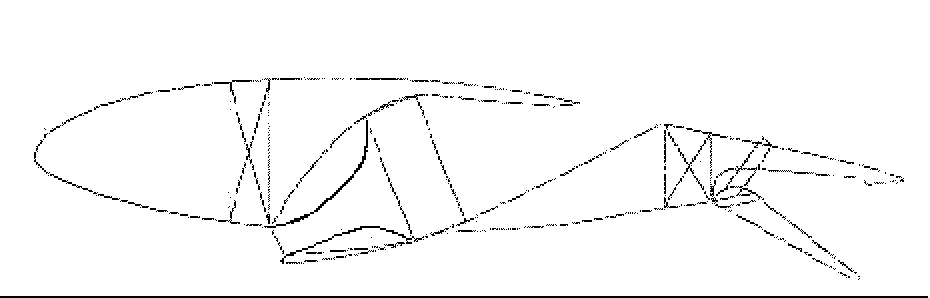
Peter, what you have shown here is old thinking on duct shape. I have modified
your sketch to show the modern thinking. The earlier design had separation
in the duct with a loss of cooling effectiveness. The other factor is rad
thickness. Rad thickness must be kept to two inches or less to insure adequate
cooling mass air flow at climb speeds around 100 MPH. A 100% effective duct
will generate 26 pounds per square foot or a pressure of 0.18 psi across
the rad at 100 MPH. A typical duct will be about 80% efficient so that is
only 0.14 psi. This is why a thin rad is called for in GA airplanes.

If your duct works perfectly you will need about 500 to 600 cubic inches based on
our members experience to cool a 13B.

7 X 2 = 14  square inches. 600 cubic inches divided by 14 square
inches equals 43 inches  so one rad in the wing seven inches high and two
inches thick  would need to be 43 inches long. One in each wing of course would be
22 inches long each. Plumb them in parallel to keep the temperature as high
as possible in both rads to maximize the heat transfer rate. The problem with
this scheme is the wide intake ducts will result in rather high drag and some
loss in lift.

A thicker wing with a taller rad would allow a shorter rad of course.
You can always climb at a higher speed, a shallower angle  and use a thicker
rad if you live in Florida :-) The pressure across the rad is proportional
to the square of speed so if you are always climbing at 120 MPH perhaps the
rad can be 44% thicker.

Paul Lamar

The AirCraft Rotary Engine NewsLetter.              Powered by Linux.

http://home.earthlink.net/~rotaryeng/            http://www.linux.org