Finn Lassen wrote:
Tracy has told me that 0.7 volts from the oxygen sensor is best power
mixture; more is rich and less is lean.

I've been seeing .8 to .9 volts and so decided to lean (drill the jets
smaller) the two outer carbs. Well, seems engine starts running more
rough, even when I still see .7 volts or more. EGT shoots up (saw as
much as 1,760F), cowling starts melting, etc.

Is it possible that the O2 sensor could fail in the direction of
indicating too rich when it's really lean?

Finn
Tracy Crook wrote:
Your experience is radically different than mine.   I suspect something else
is throwing the results off, maybe the O2 sensor but not likely in view of
all the other inconsistant results.   The O2 sensor (assuming it is after
the collector) assumes that both rotors are running the same mixture.  Are
you sure they are?  (EGTs same?)  Is your instrumentation accurate?
Equalizing mixture is one of the most difficult things to do with carbureted
engines.  I can run the mixture down (using manual mixture control on EC2
EFI) to the point where it is almost off the bottom of the scale (<.2v) and
the engine is still dead smooth.  The EGT is well below peak and power has
fallen off.   Your EGT of 1760 is almost exactly what mine reads at peak
EGT.  This is normal and if you are melting your cowl, you need to go back
and re-think the system.

On the exhaust system, I am so impressed with how well the under the
fuselage muffler system worked functionally (never mind the questionable
materials I used to kluge it up) that I would now reccomend it.  Power was
up noticably, BSFC was better (6.0 GPH vs 6.2 GPH  for the same airspeed),
and oil and water temps fell by 5 - 10 degrees after getting the muffler out
of the cowl.  Results should be even better when I get the new system
fabricated out of 321 stainless.   The drag of the external muffler was not
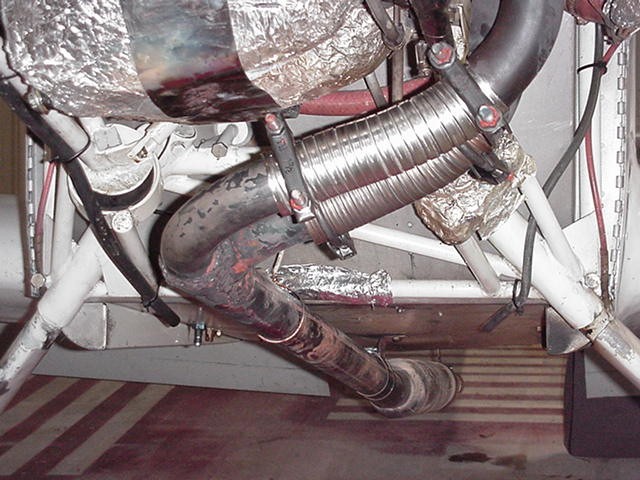
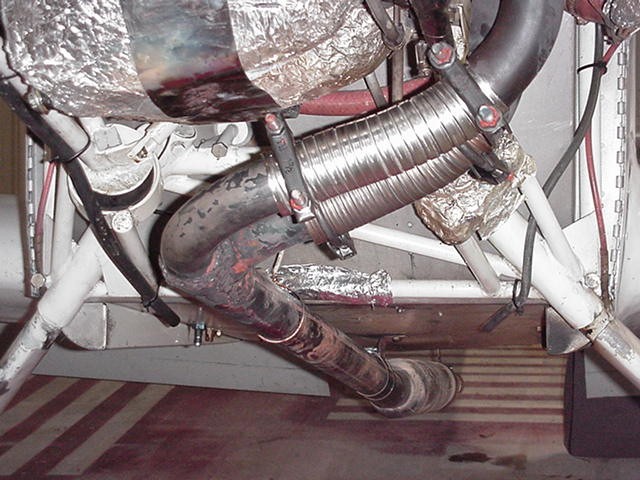
noticable.   Attached are some pictures of the old muffler and the temporary
"Swiss" exhaust made from thin wall mild steel and a Thrush glass-pack
muffler.   Note the O2 sensor on the old muffler and on the collector of
"Swiss" system.  This has been in service for several years and seen about
85 hours of 100LL use.  Still works fine on a mixture monitor but would
probably not work on a closed loop EFI system due to slow response caused by
the leaded fuel.  I highly recommend using a mixture monitor.

In the left side view, note the use of aluminum foil as a shield against
radiated heat from the exhaust system.  Remember that these pipes are bright
orange in flight.  Air flow alone will NOT protect things around these pipes
any more than a cool breeze will keep you from getting a sunburn at the
beach.

In the front view, note the scaling on the lower pipes which are mild steel.
This photo was taken after only a 30 minute test flight on the exhaust
system.

Tracy Crook
rws@altavista.net
www.rotaryaviation.com
Tracy sent four pictures but some people still are having trouble receiving more
than one at a time. (Set your max size of message up in your browser or email
program.) I will send each one in a separate message.

That rotary really did in that mild steel muffler system in short order :-).
Tracy got only as far as Texas and had to turn back. Please give us a narrative
on your trip Tracy.

Paul Lamar

The AirCraft Rotary Engine NewsLetter.              Powered by Linux.

http://home.earthlink.net/~rotaryeng/            http://www.linux.org