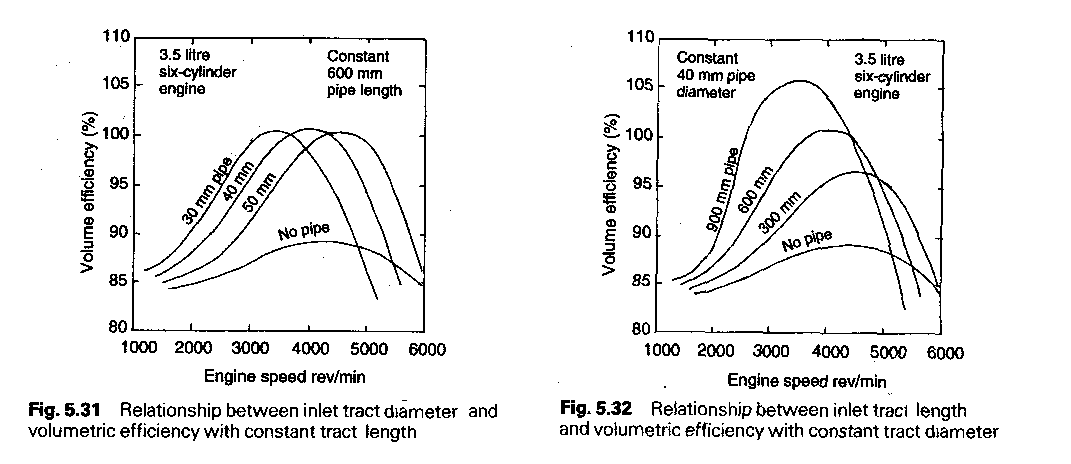
This chart is from Heinz Heislers book  "Advanced Engine Technology"
page 246, 247 SAE. this could explain why many people tuning engines on
dyno's could be confused about intake velocity. To add insult to injury
the publishers of Heinz's book got the captions  wrong on the diagrams!

I have corrected the captions. As you can see with a constant pipe length
the RPM where peak VE occurs, hence peak torque varies with pipe diameter
and of course intake velocity. This could confuse the heck out of somebody
tuning an engine on a dyno and lead to erroneous conclusions if they did
not also optimizing pipe length at the same time they changed diameter.
Notice there is no improvement in VE with different pipe diameters. Only
the peak VE varies with RPM. There is however a strong improvement in VE with
longer pipes! A good well tuned rotary intake system is well over 120% VE over
a wide RPM range because there are no poppet valves getting in the way.

What is not shown here is pipe diameter as a function of a 900 mm  pipe length.
Mazda is  world famous in the automotive industry for their computerized  parameter
lab testing and I am sure they thoroughly investigated these relationships
for the four rotor Lemans engines.

With most plenum systems with one throttle body the air fuel mixing and the
velocity in the intake runners has little to do with the size of
the throttle body. The air and fuel is mixed way down stream from the
throttle body mounted on the plenum. A throttle body too small only results in less
air mass in the plenum. There is a pumping loss through the too small
throttle body. The pressure in the plenum is then less than atmospheric.
If the throttle body is too large and the plenum is at atmospheric
pressure there is no effect what so ever at max power.

Further more it matters not at all for max power where the throttle body
is located.  It could be right next to the port or at the input side of
the plenum to mention the two extremes. Power Sport locates the throttles
right in the rotor housing itself for good idling characteristics
and yet the Power Sport  NA engine develops 215 HP at 6000 RPM.

For those that might say "yes! the Power Sport and the Lemans engines
were peripheral port engines and the data does not apply to side port
engines I refer you again to the charts below showing results with a
piston engine with intake ports restricted by poppet valves.

Paul Lamar

The AirCraft Rotary Engine NewsLetter.              Powered by Linux.

http://home.earthlink.net/~rotaryeng/            http://www.linux.org