Wrathall Mark wrote:
Snip Paul Wrote> A two rotor version of this engine would give 240 HP at
6000 RPM. Here is a cross section of the induction system and rotor housing.

Paul, where did you obtain this Le Mans cross section from? Are you sure of
it's accurracy? Why would you have a larger intake than exhaust on a PP?
I am sure of its accuracy as I have seen other pictures of this engine.
Several are raced in the US road racing circuit by some guy in Atlanta.
I think his name is Jim Downing. Lynn may know more about him.

Mazda wrote a paper on the Le Mans engine. "Mazda 4-Rotor rotary Engine for the
Le Mans 24-Hour Endurance Race" SAE 920309. Intake area is always larger
than exhaust area for the past 90 years or so in all internal combustion
engines. IMHO the pressure in the exhaust is higher so less area is needed
to empty the chamber. That may not be true in the case of turbo charged
engines however. In those cases things might be different.

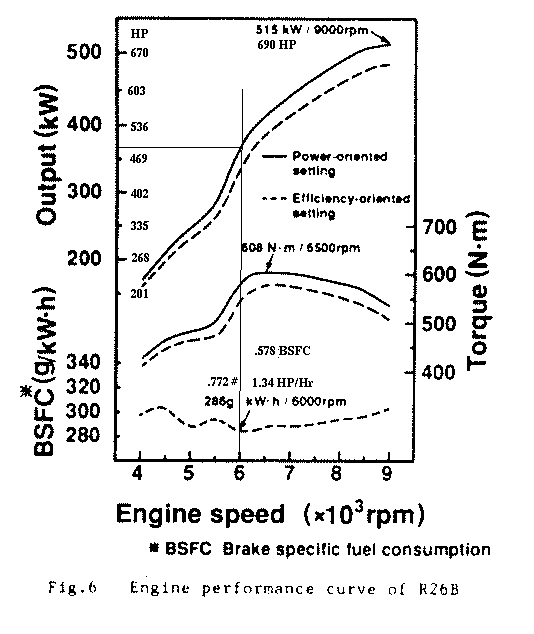
This HP chart is also from this paper. I have added the conversions
from KW to HP. Lots of other very interesting stuff in this paper.
The engine was in better shape after the race than before. Just well
broken in :-) The engine weighed only 180 kg or 396 pounds for a power
to weight ratio 1.74 HP per pound. This could be a world's record
for internal intermittent combustion engines. No IC aircraft engine
has ever come close not counting turbines of course. I suspect that included
the intake manifold, ignition system, alternator and starter.

Of course the European racing organizations outlawed the engine right away
as it looked like Mazda would win all the Le Mans races for the foreseeable
future despite a minimum weight limit which is a handicap for rotary engines.
That would be a huge embarrassment to all the legendary European
car makers as they would have a tough time explaining it to their customers
why they were not building rotary engines.

Paul Lamar

The AirCraft Rotary Engine NewsLetter.              Powered by Linux.

http://home.earthlink.net/~rotaryeng/            http://www.linux.org