Well Keith pardon me for being a bit skeptical but when you guys get
500 hours on one of those things let me know :-) Jim Mederer and I
talked about mounting the redrive pinion on the end of the e-shaft and
he too was a bit skeptical. It is not as if this has never been tried
before
in aircraft engines. Allison did a lot of work on this arrangement
as did Rolls Royce back in the 30's and they were both six power pulses
per rev V12 engines. Rolls wound up using a quill shaft to isolate the
torsional vibrations. You guys need to get a lot more hours before I will
be totally convinced.

Paul Lamar
Keith Hole wrote:
Hi Paul,

It's great to hear that people are thinking about what has been done, both
with the Mazda, and other engines.  One method of development involves
building something, then running it until failure occurs.  The method that
we chose was to validate the design with scientific test methods, and then
fly it.  The vibration analysis performed by vibration specialist Dr. R.
Eschelman, proved that our reduction drive was free from harmful resonant
frequencies within the operating range of our engine.  With that very
important step completed, we continue to put hours on our RV-6, and are
even able to run on one rotor without a noticeable increase in vibration.
 You may remember that Everett Hatch had 500 hours on a similar internal
spur gear drive, without the benefit of modern bearing technology, or a
formal vibration analysis.

While some skepticism is natural until a period of time passes, is it wise
to put more trust in a product that is known to have many resonance related
failures?

Keith Holm
Powersport Aviation
The last time I saw Everett's airplane fly at Sun&Fun Allan Tolle had a gear box failure.
Bill Freeman was with me at the time. I went to Oregon after that and photographed
the parts of the gear box in a disassembled state. Shortly after that Everett died
in an unrelated aircraft accident.

IMHO the failures we are seeing with the Ross psru are not due to torsional
resonance problems. It is due to the simple lack of a helical gear thrust bearing.

There are other issue when mounting a spur gear directly to a crankshaft
or eccentric shaft besides torsional resonance problems. There are spur gear tooth
separation loads and side loads on the e-shaft main bearing that it was
not designed to take. Planetary gear sets have no such loads as the sun gear
is located by the planets which are in turn located by the ring gear.
This is one reason why the majority of geared aircraft engines in the
world use planetary gear sets. That and the fact they are lighter than
equivalent HP spur gears. What does your gear box weigh?

Assuming for the moment the Mazda main bearing was over designed to the point that
it accepts these side loads with no problems and that you have some how
installed another bearing on the outside of the gear, perfectly aligned
with the main bearings in the the rotary engine to take half the  side loads,
what happens when the bearings wear at different rates?

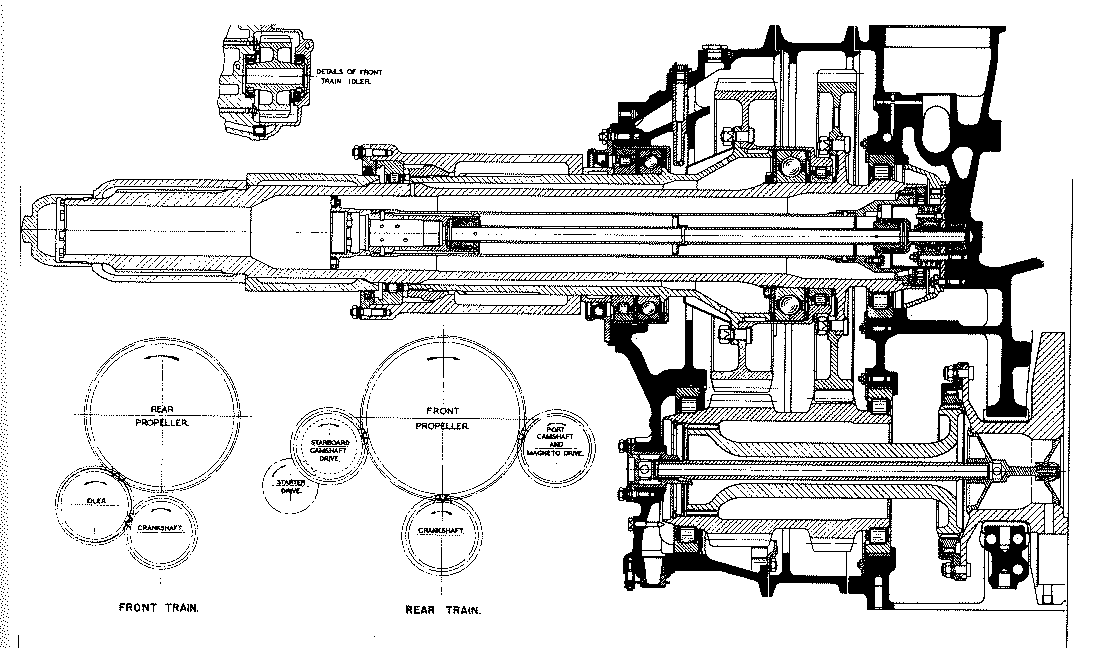
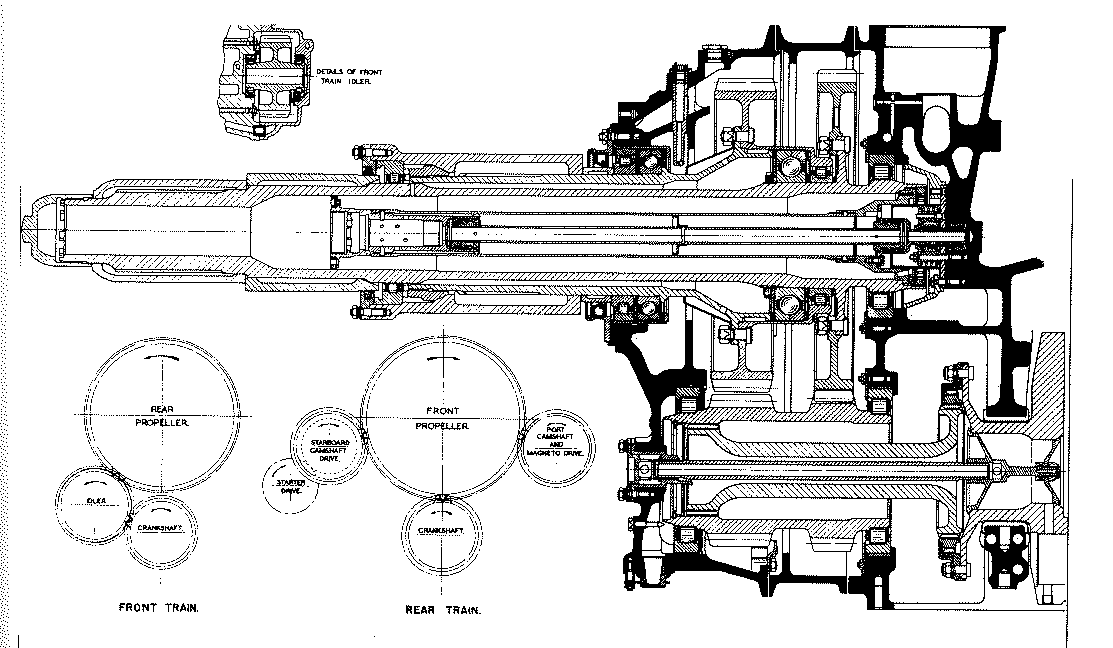
This drawing is of the Rolls Royce Griffon spur gear box. The Griffon is a larger
higher HP version of the Merlin and was designed after benefiting from Merlin field
experience. Note that the spur gears are supported by two large dedicated
roller bearings and the drive is taken from the crankshaft with a spline and
a flex quill shaft. The crankshaft main bearing is not used to locate
the spur gear pinion.

I am not saying your gear box won't work but I also will not admit Ross or
planetary gear boxes are no good. IMHO quite the contrary. We have far more
hours on various planetary gear boxes connected to rotaries than we have on
spur gear boxes at this time.

Paul Lamar

The AirCraft Rotary Engine NewsLetter.              Powered by Linux.

http://home.earthlink.net/~rotaryeng/            http://www.linux.org