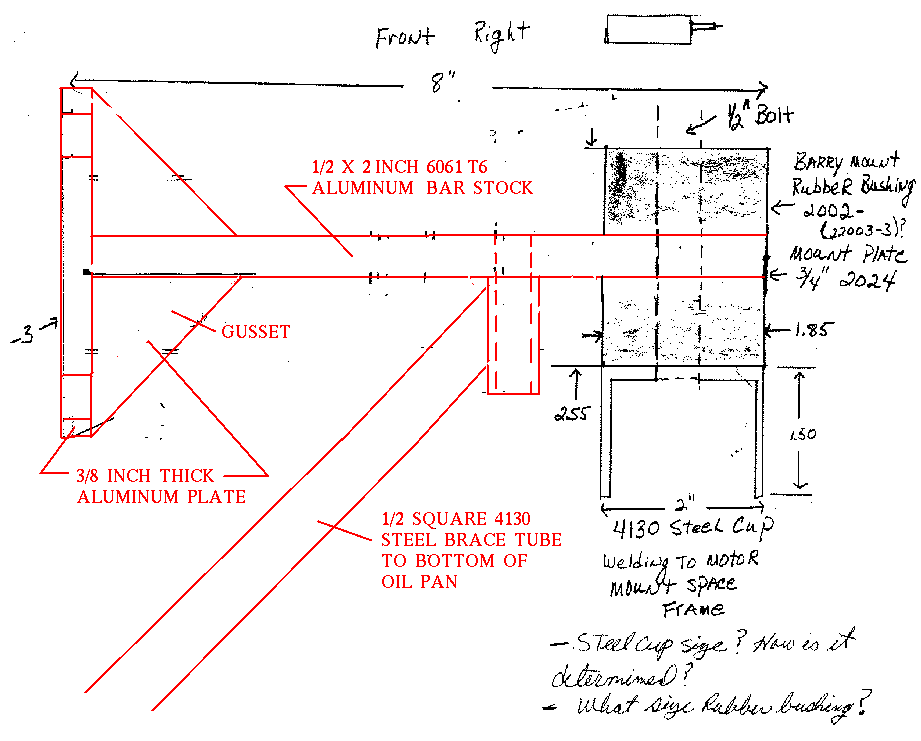
This is a modified sketch of Leonard's motor mount bracket. Front view.
It is intended to be bolted to the side of the block with four large
bolts.

There are two ways to approach this. The sledge hammer approach is beef
up this bracket and make it take all the bending loads due to dropping
in the airplane or pulling six G's. Six times 390 pounds is 2340 pounds.
That is what the engine weighs during a six G pull out. Since this
bracket is eight inches long and it takes half the load that would be about
9400 inch pounds or about 780 foot pounds. If you could beef the bracket
up to take those kinds of bending loads it would probably crack the block.

The better way is shown in the sketch. Brace the bracket to the bottom of
the pan with a bolt on 1/2 square .049 4130 steel tube.
This will easily take the vertical loads in tension. A 1/16 thick
4130 steel strap one inch wide should be welded across the bottom of
the pan to take the transverse side to side tension load. Assuming of course
the pan is a stock steel oil pan.  The 1/2 inch square tube can be
welded or bolted to this strap.

The bracket should also be braced fore and aft with a 1/2 square tube
to take the thrust loads.

Most of the bracket is made from thick aluminum plate. You will need to
find someone with a 400 amp tig welder to weld aluminum plate this thick.

You could also fabricate it from much thinner sheet steel and use a large
aluminum washer bolted to the steel with flat head screws to act as a seat
for the Barry rubber bushings.

Paul Lamar

The AirCraft Rotary Engine NewsLetter.              Powered by Linux.

http://home.earthlink.net/~rotaryeng/            http://www.linux.org