Bill Freeman wrote:
Hi All !

I suspect most of you have heard the old saw " With
enough thrust, I could make a brick fly."  or some variation
on the theme.   Here is at least partial proof.
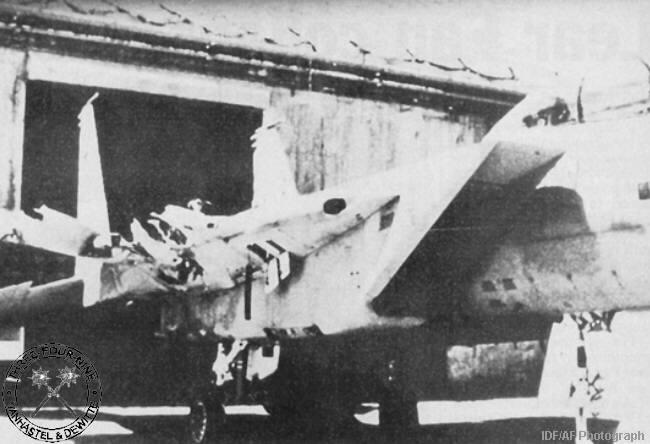
An old story, but I never heard it before and the pix,
while B&W, are impressive proof. I cleaned this up from a
FWD from another air junkie who passed it on to me.

Amazing !

Bill
 This is absolutely amazing. Resist the temptation to open the
pictures,  which are at the end, until you've read the text.


  On May 1st. 1983, a simulated dogfight training took place between
two  F-15D's  and four A-4N Skyhawks over the skies of the Negev desert. The
F-15D (# 957,  nicknamed 'Markia Shchakim', 5 killmarks) was used for the
conversion of a new pilot in the squadron. Here is the description of the
event as described in "Pressure suit":

  "At some point I collided with one of the Skyhawks, at first I didn't
  realize it. I felt a big strike, and I thought we passed through the
jet stream of one of the other aircraft. Before I could react, I saw the
big fire ball created by the explosion of the Skyhawk. The radio started
to deliver calls saying that the Skyhawk pilot has ejected, and I
understood that the fire ball was the Skyhawk, that exploded, and the pilot was
ejected automatically.

  There was a tremendous fuel stream going out of the wing, and I
understood it was badly damaged. The aircraft flew without control in a strange
spiral. I re-connected the electric control to the control surfaces, and
slowly gained control of the aircraft until I was straight and level again.

  It was clear to me that I had to eject. When I gained control I said
:"Hey,  wait, don't eject yet!". No warning light was on and the navigation
computer  worked as usual; I just needed a warning light in my panel to
indicate that  I  missed a wing..."

  The instructor ordered me to eject. The wing is a fuel tank, and the
fuel indicator showed 0.000 so I assumed that the jet stream sucked all
the fuel out of the other tanks. However, I remembered that the valves operate
only in one direction, so that I might have enough fuel to get to the
nearest airfield and land.  I worked like a machine, wasn't scared and didn't
worry.   All I knew was: as long as the sucker flies, I'm gonna stay inside.

  I started to decrease the airspeed, but at that point one wing was
not enough.  So I went into a spin down and to the right. A second before I
decided to eject,  I pushed the throttle and lit the afterburner. I gained
speed and
thus got control of the aircraft again. Next thing I did was lowering the
arresting hook.
  A few seconds later I touched the runway at 260 knots, about twice
the recommended speed, and called the tower to erect the emergency
recovery net.
  The hook was torn away from the fuselage because of the high speed,
but I managed to stop 10 meters before the net. I turned back to shake the
hand of my instructor, who urged me to eject, and then I saw it for the first
time  -   no wing !!!

  The IAF (Israeli Air Force) contacted McDonnell Douglas and asked for
information about possibility to land an F-15 with one wing . MD replied that
this is aero- dynamically impossible, as confirmed by computer simulations...
Then they received the photo.... After two months the same F-15 got a new
wing and returned to action.

  Special thanks to Tsahi Ben Ami."

  This is what "Flight international, 8 June 1985" wrote about the
incident :

  "The most outstanding Eagle save was by a pilot from a foreign air
force.  During air combat training his two seater F-15 was involved in a
mid-air collision with an A-4 Skyhawk. The A-4 crashed, and the Eagle lost
its right wing from about 2ft. outboard.

  After some confusion between the instructor who said eject, and the
student who outranked his instructor and said no, the F-15 was landed at its
desert base.
  Touching down at 290 kt, the hook was dropped for an approach and
engagement.  This slowed the F-15 to 100 kt, when the hook weak link
sheared, and the aircraft was then braked conventionally.

  It is said that the student was later demoted for disobeying his instructor,
then promoted for saving the aircraft.  McDonnell Douglas attributes the saving
of this aircraft to the amount of lift generated by the engine intake/body
and "a
hell of a good pilot"."
The AirCraft Rotary Engine NewsLetter.              Powered by Linux.

http://home.earthlink.net/~rotaryeng/            http://www.linux.org