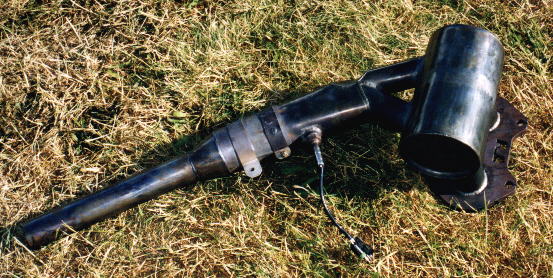
I just made some calculations on the weight
 of a tangential muffler made from .049 thick SS or Inconel.
 Tracy's .035 thick SS muffler lasted about 1000 hours.

 Six inches in diameter 10 inches long cover...... 2.7 pounds
 Two, 2 inch dia. pipes 3 inches long from engine.  .55
 Two ends, six inches in diameter.................. .83
 One 20 inches long 3 inch in dia. Down pipe...... 2.7
 Total............................................ 6.78 pounds

 The exhaust flange is not included as it will be more
 or less the same weight for all mufflers.

 Paul Lamar
Finn Lassen wrote:
>From my limited experience, I agree. My home made 4"x6"x12" oval muffler,
fed by
2"D, 3" long straight header pipes, and 2" exhaust pipe diagonally through
it,
reduced exhaust noise so well that it was barely noticeable over prop
noise. I could
probably have made it work by bellows or flex pipe in the header and
exhaust pipes
to avoid cracking. However, I was very uncomfortable with all the heat
under the
cowling and necessary heatshields around it (which made regular inspections
for
cracks very difficult).

Finn
Paul,
I agree with you that the tangential muffler could be very efficient, however
based on input from an engineer friend, and Finn's experience, and Tracy's
with the 1000 hour life with an 0.035 stainless muffler, I have come to the
following position.

1. A tangential muffler with short pipes close coupled to the engine is
likely to fail due to differential thermal expansion causing the welded joint
at the tangential pipe to the muffler to be fatigued.  Finn had a failure
like this.  My engineer friend had multiple failures like this when working
on a close-coupled exhaust thermal reactor at Ford.

2. The same muffler mounted a couple of feet away has lasted a long time
(Tracy). IMHO, this is because the longer exhaust header pipes allow more
movement as the muffler heats up, and reduces the stress on the pipe-muffler
joint.

3. Problem #1 can be avoided by the use of bellows for expansion relief
(expensive) or by approach #2.

4. Chuck Dunlap's muffler also avoids this problem, and I believe that you
commented that it was very quiet.

My current choice, a tangential muffler located like Tracy's or Chuck's.

Bill Schertz
I don't agree that it will necessarily crack. In any case
no problem. Just put a large slip joint in the muffler itself.
I'll make a drawing soon.

BTW Dave Atkins has been flying with one made from thin Inconel for at least 400 hours.
As I recall  it weighs four pounds less the flange.

Paul Lamar

The AirCraft Rotary Engine NewsLetter.              Powered by Linux.

http://home.earthlink.net/~rotaryeng/            http://www.linux.org